Showing posts with label Illustration. Show all posts

Monday, October 2, 2023

Didier Graffet, French Steampunk Illustrator

Didier Graffet, born 1970, is a French painter/illustrator specializing in Steampunk and fantasy subjects.   Some background regarding him is here.

As best I can tell, most artists of that genre nowadays produce digital images.  Graffet, however, seems to have mostly or entirely painted using acrylics.  That is more laborious than digital, given the amount and type of detail he uses.  But the result is something tangible that can be sold for a good price, if auction values for some of his works are any clue.

Below are examples of his paintings found on the Internet.

Gallery

Angel City
First, to place Graffet's work in context, a fine example of digital Steampunk art by the well-known Stephan Martinière.

A New York City fantasy by Graffet.  He compresses Broadway, showing the 23rd Street's Flatiron Building (slightly altered) in the middle ground and Times Square closer in.

Detail of the previous image.  The Paramount Theatre at the right is in the same spirit as the actual Paramount of the late 1920s.  The nearest southbound car is a Jaray-type streamlined Maybach of 1935.  Other cars seem to be Graffet's inventions, as is the double deck bus at the left. 

A country scene with castles in the background and Viking-type ships approaching us.

Graffet used that vehicle's shape in several of his paintings.

Here one is at a loading platform.  The people on the balcony are dressed in circa-1920 fashion.

Trafalgar Celebration
Trafalgar Square, London.  HMS Victory sits by Nelson's monument while a huge dirigible loiters overhead.  The people are dressed as in the 1890s.

Métro Gare du Nord
The train station for points north of Paris.  The façade is there, but far, far above street level.  The sign fragment at the upper left advertises trains for London.

Le Tour
Eiffel Tower as seen from across the Seine.  Some of the airships are steam powered, highly unlikely in reality, but found in Steampunk illustrations by other artists.

Monday, September 18, 2023

Bartow Van Voorhis Matteson - 1920s Illustrator

Bartow Van Voorhis Matteson (1894-1984) was an illustrator active in the 1920s who might have transitioned to Fine Arts later during his long life.   I can find virtually no biographical details about him on Google and Bing searches or in my reference library.

Below are some examples of his illustration work, most from the 1920s.  Some are competently done, and appeared in some of the better magazines.  A few others are of lesser quality.

Gallery

U.S. Army Medical Department poster - c.1918
Matteron signed this as an Army lieutenant.  I don't think this poster is well-done artistically and persuasively.

Vignette format Western romance scene
Matteson did a number of Western romance story illustrations.  This is not his best: note the poor anatomy at the man's neck and shoulder.

Farm scene
Story illustration.

The Courtship
Another Cowboy romance.  Essentially the same costume as seen above.  The girl is nicely depicted.

Under the Moonlight
From the same story as the preceding image?  Costumes are nearly the same.  Or did Matteson simply repeat the same sort of clothing again and again when called to do Western love stories?

Gypsies Paused at the Clearing
This is comparable to 1920s illustrations by better-known artists such as Dean Cornwell.

Heartache at Sea
Another competent work.

Lovers and swans scene - The Country Gentleman magazine - 1926
For reasons of printing economy in those days, many illustrations were created and printed in duotone.

The Proposal - 1930
The lady is poorly drawn: her head is too large for her body.

Monday, August 28, 2023

Paul Gerding, Automobile Advertising Illustrator


Paul Gerding (1895-1983) made a number of very nice illustrations for automobile advertisements, especially in the late 1920s to mid-1930s.  He did other work, but I found little of it on Internet searches.  Part of my problem is that illustrators did not always sign their work -- usually due to the ad agency or its client's policy.

Because of all that, I could find little more than Gerding's birth/death years.  So this post simply focuses on the examples of his work I selected.

The image above is cropped from a 1932 Pierce-Arrow advertisement.  Pierce-Arrow was a luxury brand in decline due to the Great Depression and strong competition from the likes of Packard and Cadillac.  I think Gerding did a fine job here, especially the lighting and use of color.  Media were probably watercolor and gouache.

Gallery

The advertisement source of the image at the top of this post.

Now for three 1927 Pierce-Arrow ads by Gerding.  Here the car is incidental to the people in the foreground.

Gerding painted both the car and the setting.  Often a different artist was used for each type of subject because cars are not easy to render convincingly.  Perhaps the most famous example is the long-running Pontiac series illustrated by Art Fitzpatrick (cars) and Van Kaufman (setting and people).

Again, people in the foreground, car to the rear.

Another 1932 Pierce-Arrow ad.

And another.

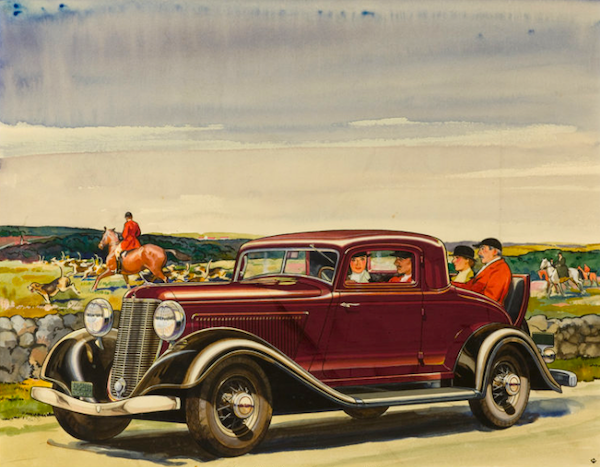
This illustration (not signed, but attributed) is of a 1933 DeSoto.

Ultra-luxury Duesenberg cars for 1935 were advertised using black-and-white illustrations by Gerding featuring seriously wealthy looking people, but no cars in sight.

Around the time of World War 2, Gerding pained a number of scenes for Republic Steel advertisements.

Monday, August 21, 2023

Louis Fancher, Illustrator

Louis Fancher (1884-1944), Wikipedia entry here, seems to have experienced a career peak in the 1910s decade if Internet images of his work are any clue.

Of course his career lasted longer, but his approach remained poster-like throughout, because it seems he illustrated many posters and magazine covers and few if any magazine stories.

The early works shown below are flat, simplified representations.  Later, he gradually added modeling.

Gallery

Scribner's Magazine poster - 1907
He was about 22 years old when he did this.

Pierce-Arrow poster - c.1910
Fancher is perhaps best known for his Pierce-Arrow posters.

Collier's cover - 18 February 1911
Collier's was a major general-interest magazine, ranking not far below the Saturday Evening Post.

Pierce-Arrow poster - 1911

Collier's cover - 26 October 1912
Another poster-style cover illustration.  In one sense, magazine covers are actually sales posters.

Simplex poster - 1916
A Pierce-Arrow competitor.

U.S. Army Air Service poster - c.1918
Fancher was in the Army during the Great War, but still had time to do poster art.

Southern Pacific poster - c.1918
Another patriotic wartime poster, this for a railroad.  Note the German helmet at the lower right.  Many had studs that could support an armor band over the front.  Here Fancher transforms the studs into devil's horns.

Judge Magazine cover - 2 April 1921
Changing style, but still a poster.

Collier's cover 3 August 1929
Flatness is pretty well eliminated here.  Not much like his earlier Pierce-Arrow work.

Collier's cover - 19 May 1934
An example of his later style.

Monday, July 24, 2023

Jean Pagès, fashion Illustrator

Jean Pagès (1903-1976), according to this web site, received architectural training before becoming a fashion illustrator.  Most of his work was for Condé Nast publications.

Like other fashion illustrators, his style was based on what was favored at the time.   In the 1920s, fairly flat, simplified images were preferred.  But as the 1930s rolled along, free-style wash drawings became preferred.

Below are examples of his work from the late 1920s to the mid-1930s showing his stylistic shift.

Gallery

Vogue illustration - c.1927
Geometric feeling ... perhaps a reflection of his architectural training

Vogue (Germany) cover - 19 December 1928
German Vogue cover illustrations tended to be simpler than those for France, Britain and the USA.

Vogue illustration - April 1929
Tenniswear fashions.

Illustration - 1931
Again, architectural referring training allowed him to convincingly depict shadows and interior structures.

Vogue cover - 1 June 1931
Matelot style costume.

Vogue illustration - 15 April 1933
Pagès' style is becoming more loose.

Vogue (USA) cover - 15 December 1933
Horrors!!  She's smoking!

Vogue (USA) cover - 1 October 1934
No drama in this pose.

Illustration - 1935
His work shows less free brushwork than the fashion illustration norm of the time.

Illustration - 1936
This is more in the new style.  Similar looking fashion illustration was common in the 1950s.

Monday, June 26, 2023

Pierre Mourgue, Fashion Illustrator

Pierre Mourgue (1890-1969) was an important French fashion illustrator.   Some biographical information is here.

Much of his work was published in Condé Nast's Vogue Magazine's French, British, American and German versions.  Examples are shown below along with other illustrations whose sources were not clear from Internet sources.

It seems that fashion illustration, along with its subject matter, follows its own set of fashions.  1920s illustrations tended to simplify human figures and clothing, creating flattening to various degrees depending on the artist or perhaps the art director.  In the 1930s fashion changed to free-style wash drawings, this persisting into the 1950s and beyond.  There also seem to have been some national differences, as Mourgue's 1920s cover illustration for German Vogue are more simplified than those he did for other editions.

In two words, Mourgue was both fashionable and versatile.

Gallery

Monsieur magazine cover - February 1921
Some of his comparatively early work was for a men's magazine.  Doesn't look like that guy on the right spent much time in the trenches around Verdun.

Illustration - 1927
Mourgue's illustrations sometimes used more shape modeling than was common at the time.

Illustration - 1928
Not a fashion illustration.

Vogue (Germany) cover - May 1928
An example of his simplified German style.

Vogue (USA) cover - 15 September 1928
Mourgue traveled to the USA a lot, according to the link above.  The background of this illustration seems to be a greatly enlarged New York Central Park lake.

Vogue (UK) cover - March 1929
All is flatly done save the car's steering wheel.

Vogue illustration - 1932
New decade, new fashion trend.

Patou dresses - c.1934
Original publication illustration, probably for French Vogue.

Vogue (USA) cover - 1 March 1935
The new fashion illustration style.

Vogue cover illustration - 1935
Another example.