Showing posts with label Portrait subjects. Show all posts

Tuesday, October 8, 2024

Up Close: William Orpen's Adrian Carton de Wiart

Sir William Newenham Montague Orpen (1878-1931), Wikipedia entry here, is perhaps best-known for his portrait work and Grear War related paintings.

Combining those was a series of sketch-portraits of senior British officers, some of which I featured here.  One of those portraits was of Adrian Carton de Wiart (1880-1963), an incredibly brave recipient of the Victoria Cross.  Wikipedia mentions: "He served in the Boer War, First World War, and Second World War.  He was shot in the face, head, stomach, ankle, leg, hip, and ear; was blinded in his left eye; survived two plane crashes; tunnelled out of a prisoner-of-war camp; and tore off his own fingers when a doctor declined to amputate them.  Describing his experiences in the First World War, he wrote, 'Frankly, I had enjoyed the war.'"

I also noted that portrait here.

In September of this year I once again found myself in London's National Portrait Gallery.  Instead of using my Nikon Coolpix that nearly always gave me trouble photographing paintings accurately, I now used my iPhone.  Three images I took of that 1919 portrait are shown below.

Gallery

The whole thing.  Better-framed images of it can be found elsewhere on the Internet.

The part dealing with the subject.  Orpen took care depicting the face, but things become sketchier farther down.

Closer view of the sketchy part.  For me, an interesting lesson on technique.

Monday, June 24, 2024

Multi Ritratti: Mary Robinson "Perdita"

My "Multi Ritratti" posts that present multiple portraits of the same subject -- usually by more than one artist -- are of people who are well-known.  Well, nearly all were well-known subjects at the time they posed, though some are almost totally obscure nowadays.

That is the case of this post's subject, Mrs. Mary Robinson (1757c. - 1800).  Her life was short and tempestuous.  Her fame was due to being an actress and, for a short while, mistress of England's Prince of Wales (later King George IV).  More detail can be found here on the Wallace Collection website.

That link points out that her portraits date from a limited period in the 1780s when her affair and acting career were flourishing.  Her portraits shown below are by important artists -- Sir Joshua Reynolds (1723-1792) background here, George Romney (1734-1802) here, Thomas Gainsborough (1727-1788) here, and the less-well-known-now John Hoppner (1758-1810) here, who was a fashionable portrait artist at the time.

Gallery

Attributed to John Hoppner
Hoppner admired the work of Sir Joshua Reynolds, the link above mentioning that his colors tended to be brighter than Reynolds'.  The portrait shown here shows a glamorous lady,  dressed for her part as Perdita in Shakespeare's "The Winter's Tale."  What's remarkable is that the pose and most details are the same as found in the portrait below by Reynolds.  Did Hoppner (or some unknown painter) largely copy Reynold's painting?  What did Reynolds think of this?  I do not know.

By Joshua Reynolds
According to the Wallace link, this is credited as being the best likeness of  Robinson.  Not as attractive as shown in the previous work.

By George Romney
A less dramatic face here.  Similar pose to those shown above, but here she's dressed differently.

By Thomas Gainsborough
Said to be a poor likeness.  Also the head-neck-shoulders relationship strikes me as odd.

By Joshua Reynolds
Another Reynolds.  A bit sketchy.  But probably a decent likeness.

Monday, July 10, 2023

Queen Elizabeth II: Multi Ritratti by Edward Halliday

Edward Irvine Halliday (1902-1984), biographical information here, is not well-known today, but had a long career as a painter of portraits and murals.

Among his portrait subjects was Queen Elizabeth II.

It seems that many British organizations desired having a portrait of her.  Not just a photograph, but a real painting made with oil paints.  The Queen had many duties, and surely could not find time to pose for every requested portrait.  So Halliday, for example, painted several portraits of her posed the same, but attired differently and with different backgrounds.  I suppose other artists did the same thing, though I wasn't aware of this until I was collecting a set of images of Halliday's works.

Locations noted following Elizabeth's name are organizations that commissioned the paintings or where they are to be found.

Gallery
Princess Elizabeth - drawing, National Portrait Gallery -  c. 1949
Nice job: note the light, shadows and reflected light.

Princess Elizabeth and the Duke of Edinburgh, Britannia Royal Naval College - 1949
Phillip was only a Royal Navy lieutenant in those days.  Later he became an Admiral of the Fleet.

Elizabeth II, Walker Art Gallery, Liverpool - c. 1955
Her head seems a trifle large compared to her arms and hands.

Elizabeth II, Guildford Guildhall - 1957
Here is an early version of the pose that Halliday kept using.  Possibly this was made during an actual sitting.

Elizabeth II, Guildhall Winchester - 1957
Same costume as in the previous image.  Same pose, of course.

Her Majesty the Queen, Southampton Mayor's Parlour - 1966
Same pose, but the rest differs.  Note that this was painted nine years later.

Elizabeth II with Latimer House in the Background, Defence Academy of the United Kingdom - 1966
Many 1957 portrait details are carried over to this 1966 work.

Monday, January 2, 2023

August Macke's Portrayals of His Wife

August Robert Ludwig Macke (1887-1914), Wikipedia entry here, was a Germain artist whose brief career took place during the years when Modernist "isms" were appearing thick and fast.

But as I noted in my post "August Macke: Restrained Modernist," he experimented with various Modernist ideas, yet continued to make more representaional paintings.  That was especially true when depicting his wife, which he did a great deal.

She was Elisabeth Erdmann-Macke (née Gerhardt, 1888-1978), who as noted here, had a career as a writer after Macke was killed in the aftermath of Germany's defeat in the Battle of the Marne.

Elisabeth's best feature was her very attractive face, and Macke depicted it in many of his drawings and paintings of her.  A few of these are presented below, along with some photos of her.

Image captions are mostly as found on the Internet.

Gallery

Elisabeth
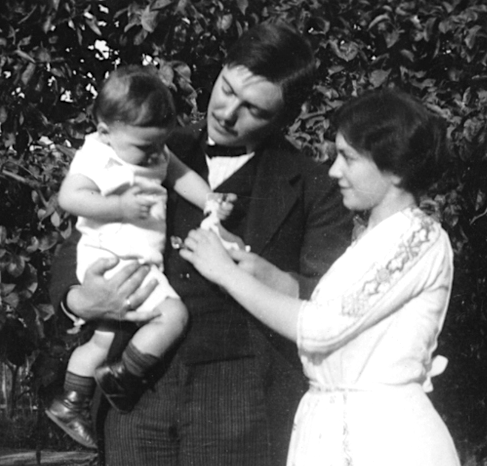
No date for this photo.  But from the youthful shape of her head, it was probably taken before her 1909 marriage to Macke at about age 21.

August Macke and Elisabeth Gerhard in Bonn - 1908
Before their marriage.  He is wearing his army uniform, most likely because he was on leave from training.

August Macke with his wife Elisabeth and son Walther in 1911

Elisabeth reading - 1919

Elisabeth Gerhardt - drawing

Elisabeth am Schreibtisch
"Elisabeth at the Writing Table."  This painting and most of those shown below feature Macke's Modernist experimentation.

Elisabeth Reading

Portrait with Apples (Artist's Wife) - 1909
Just a little Modernist simplification here.

Portraetkopf der Frau des Kuenstlers - 1912
And here, a wisp of Cubism.

Elisabeth Gerhardt
This has an Oriental feeling.

Artist's Wife (Elisabeth Gerhardt) - 1909
Expressionist, dramatic, and interesting.

Monday, July 18, 2022

Up Close: Pauline Astor by John Singer Sargent

Pauline Astor (ca. 1880-1972) was the daughter of William Waldorf Astor and granddaughter of John Jacob Astor III.  Her portrait was painted ca. 1898-99 by John Singer Sargent.  As best I can discover, it is in the William Morris Collection, and was on loan to The Huntington Library, Art Collections, and Botanical Gardens in San Marino, California, where I saw in in January of 2010.

I took a few photos of it with a digital camera that seldom did a decent job of focusing on paintings.

Sargent made Miss Astor seem like a very attractive young woman, so I thought I'd pass my photos along in this post.  Click on the images to enlarge somewhat.

Gallery

The portrait as seen at the Huntington.

Zooming in to typical portrait detail.

Showing Sargent's treatment of fabrics.

Closeup of Pauline's face.

Monday, July 4, 2022

De Laszlo Paints King Alfonso XIII and Family, 1926-27

Philip de László (1869-1937), Wikipedia entry here, was a highly successful portrait artist: considered by some the successor to John Singer Sargent.  Born and raised in Hungary, most of his career was spent in England.  Not all his later subjects were British.  For example, in 1910 and again around 1920 and 1927 he painted Spain's royalty.  Today's post presents selections from 1926-27.

Gallery

King Alfonso XII (1886-1941) of Spain
Biographical information is here.  He abdicated in 1931.

Queen Victoria Eugenie (1887-1969)
Wikipedia entry here.  She was British, a descendent of Queen Victoria, passing on genes related to haemophilia.

Alfonso, Prince of Asturias (1907-1938)
He renounced his claim to the throne in 1933, later dying due to haemophilia-indiced bleeding.

Infante Jaime, Duke of Segovia (1908-1975)
He also renounced his claim.

Infanta Beatriz (1909-2002)
She was the most long-lived of the group.

Infanta María Cristina (1911-1996)
Some biographical information is here.

Infante Juan, Count of Barcelona (1913-1993)
He was the father of King Juan Carlos I.

Infante Gonzalo (1914-1934)
He also died of complications due to haemophilia.

Monday, May 16, 2022

Molti Ritratti: King Alfonso XIII

Spanish King Alfonso XIII (1886-1941) abdicated his throne in 1931, dying ten years later in Rome of a heart attack at age 54.  Biographical information can be found here.

Even in the age of photography, kings and other royalty had formal painted portraits made of themselves.  So it was with Alfonso.  Most of the artists who painted him were Spaniards, if Internet image searches are evidence.  Some of the artists represented below are unknown to me, but three are important, one of whom was not Spanish.

Gallery

Time cover - 23 July 1928
A photograph of the king.

By Gabriel Osmundo Gómez
Alfonso's portraits usually had him posed in military attire, and the attire varied from portrait to portrait.

By Carlos Váquez Úbeda
An exception to military clothing.

By Luis Menéndez

By Mariano Oliver Aznar

By José Moreno Carbonero
This is sketchy, but the uniform he's wearing is a post- Great War dress outfit, not formal attire.  Now for some portraits by well-known artists.

By Joaquín Sorolla - 1907
In the uniform of a hussar.

By Ramon Casas
An informal depiction by Casas, who was especially skilled at depicting subjects and their personalities.

By Philip de Laszlo - 1927
Laszlo made many portraits of Alfonso and his family.

Monday, April 18, 2022

Victoria Eugenie of Battenberg by Philip de Laszlo

Victoria Eugenie Julia Ena of Battenberg (1887-1969) was Queen of Spain until 1931when King Alfonso XIII abdicated.  Her grandson Juan Carlos became King in 1975. Her Wikipedia entry is here.

Below are portraits of her painted by Philip de Laszlo (1869-1937 -- biographical information here).  He came from Hungary to become a leading British portrait artist.  Besides his portraits, I included two photos of the Queen for comparison.

Gallery

Painted in 1910, four years following her marriage to King Alfonso.

Painted in 1912.

This painting is dated 1920.  She was in her early thirties and Laszlo didn't have to work very hard to glamorize her.

From around the same time.  This formal portrait was less glamorized.

Photo of Victoria Eugenie from 1922.

This was part of a series Laszlo painted of her, the King, and each of their children.

A 1927 sketch or study he made in preparation for the portrait below.

The Queen wearing a mantilla, 1927.

Victoria Eugenie in 1930.