Showing posts with label Museums. Show all posts

Monday, September 27, 2021

Some Norman Rockwell Studies

I was touring New England in June and made sure to visit the Norman Rockwell Museum in Stockbridge, Massachusetts.

On display were some examples of Rockwell's studies for his Saturday Evening Post cover art.  His studies were extremely detailed, little different from the final art apart from being drawn in pencil and lacking color.

Although this was highly labor-intensive, Rockwell in later years had an assistant to do some chores such as transferring a drawing to canvas, taking care of oil paints, cleanup, and such.

Below are some iPhone photos I took.  Click on them to enlarge.

Gallery

Land of Enchantment - 1934
These are sketches of details and not a full-scale study.

The finished painting.

A detail derived from the lower sketch.

Detail based on the upper sketch.

The Gossips - 1948
Study for one of his most famous Post covers.  Note the size compared to the nearby information plaque.

Detail featuring Rockwell's wife.  He pictured himself on the bottom row of the previous image.

Mermaid - 1955

The mermaid seems pretty sexy for the 1955 Post, but the final was the same pose as here.

The Art Student - 1955
This compared the study with the final art.  Most of the background details differ, so it's likely that a later study was made.

Just Married - 1957
This is highly detailed indeed.  Note that Rockwell paid attention here to light-dark values using other media then pencil.

Detail of the figures.

Monday, September 13, 2021

Paintings at Daniel Chester French's "Chesterwood"

Daniel Chester French (1850-1931), Wikipedia entry here, was probably the most noteworthy American sculptor following the death of Augustus Saint-Gaudens.  His most famous work is the statue of the seated Abraham Lincoln in Washington DC's Lincoln Memorial.

French lived many years in his Chesterwood estate in Stockbridge, Massachusetts.  It's not far from the Norman Rockwell Museum in the same township, and well worth a visit if you are in the area.

Today's post does not deal with French's sculptures.  Instead, it features some paintings I spotted while touring Chesterwood.  Two are by French himself, who handled paint brushes nearly as well as sculpting tools.  The others are by artist friends of his.

Images are iPhone 12 photos I took along with some that I found on the Internet.

Gallery

Portrait of French by John Christen Johansen
(1876-1964), a well-known portrait artist in his day.  My photo.

Display case with paintings -- panning right-to-left, first image.

French's 1914 portrait of his daughter Margaret French (1889-1973) ... Wikipedia entry here.

Display case, second image.

Another painting of Margaret by French.

Portrait of Margaret by Robert Vonnoh (1858-1933).  Apologies for the poor resolution, but that was what the Internet had.

Photo of Margaret in the same setting.

1934 Photo of sculptor Margaret French Crosson with bust of her father.

Display case, third image.

Portrait of Daniel Chester French by Robert Vonnoh, 1913.

Display case, final image.  These portraits are probably by Johansen.

Monday, August 23, 2021

Fantasy Art at the Norman Rockwell

If you are interested in American illuatration and find yourself in the vicinity of western Massachusetts, a must-see site is the Norman Rockwell Museum in Stockbridge.  While it displays many of Rockwell's works, it also has exhibits dealing with other illustrators.  Until 31 October of this year there's an exhibit featuring fantasy illustration.

For some reason illustrations of dragons and other mythical creatures don't interest me very much, so I skipped through the exhibit quickly, focusing my iPhone on works by illustrators who do interest me.  Those works had minimal monster content.

Below are some of my photos.  Featured are details of the original artwork for readers interested in technique.  They are presented in chronological order.  Click on images to enlarge.

Gallery

"The Black Eagle of Prussia" by Gustave Doré - 1871
I think of Doré in terms of etchings.  Of course he could paint, and in color.  This is a black and white painting dealing with the 1870-71 Franco-Prussian War that ended badly for the French.

Detail showing an angel fending off the evil eagle of Prussia.

"The Other Side" by Dean Cornwell - 1918
Cornwell usually dealt in conventional subjects, so this fairly early work is interesting in that he didn't need to research setting details.

Cornwell made use of oil paint and impasto during the first 15 or 20 years of his career.

"Lady Violetta and the Knave" by Maxfield Parrish - 1924
Parrish's style is the antithesis of Cornwell's.

He made considerable use of glazing in his Fine Art works, though perhaps not so much here.

"The Planet Wizard" book cover by Jeffrey Jones - 1969
This is slightly cropped.  A fairly early Jones that has hints of Frank Frazetta's style.

"Beauty and the Beast" by Thomas Blackshear - 1994
Blackshear, aside from postage stamp designs, seems to do more Fine Art work than illustration.

Detail.  Note hints of Gustav Klimt.

"The Creek" in "The Conquering Sword of Conan" by Gregory Manchess - 2005
Manchess' style is strong and painterly.

His brushwork in this small illustration is worth study.

Thursday, July 8, 2021

N.C. Wyeth at the Farnsworth

Newell Convers (N.C.) Wyeth (1882-1945), Wikipedia entry here, was one of the leading American illustrators during the first decades of the Twentieth Century.  As Wikipedia mentions, his non-illustration paintings were often explorations into various fashionable Fine Art styles.  From the David Michaelis' biography I gleaned that N.C. felt illustration was lesser than Fine Art and hoped to establish a good reputation in that field as well.

I wrote about that here, featuring one of his Fine Art attempts I'd seen at the Branywine River Museum in Pennsylvania a few years ago.

It happens that more such works can be seen at the Farnsworth Art Museum in Rockland, Maine (museum site here, Wikipedia entry here).  The Wyeth family spent many summers in Maine and Betsy James Wyeth (1921-2020), Andrew Wyeth's widow, donated a number of works by N.C., Andrew and Jamie to the Farnsworth.

Below are iPhone photos I took when visiting the Farnsworth around the 10th of June of this year.  Images of entire works are uncropped and include the nearby information plaques to provide a sense of the paintings' sizes.

Raw images are larger than usual here, so feel free to click on them for significant enlargement.

Gallery

"Westward Ho" endpapers illustration - 1920
This was the only example of N.C.'s illustration work on display.  Its composition is influenced by the endpaper vertical fold line running down the center.

"Westward Ho" detail
Wyeth's illustrations were usually quite "solid" in their treatment of people and key objects.  His Fine Art works varied from this to one degree or another.

The Harbor at Herring Gut - 1925
Here Wyeth seems to be trying out "naïve" (untrained) art: note the unrealistic sizes of some of the subjects.

Lobsterman - 1927
This is the most abstract of the paintings I saw.  Very large, rather interesting.  But he seems not to have pursued this approach further.

Cleaning Fish - 1933
Solid details, but twisted perspective and other wisps of Expressionism.

Untitled - Port Clyde Harbor scene - 1933
Unfinished painting left at the charcoal-on-canvas stage.

Untitled, detail
This probably reflects N.C.'s illustration procedure.

Fisherman's Family - c. 1933-34
Again, a little Expressionism, but coupled with 1930s modernist simplification.

Fisherman's Family study
Apparently Wyeth was dissatisfied with the composition.  One eliminated detail is the boy at the left.

The Morris House, Poert Clyde - c. 1937
The latest of the paintings I saw.  It vaguely reminds me of Edward Hopper paintings of buildings.  Could N.C. have been influenced by Hopper here?

Monday, November 4, 2019

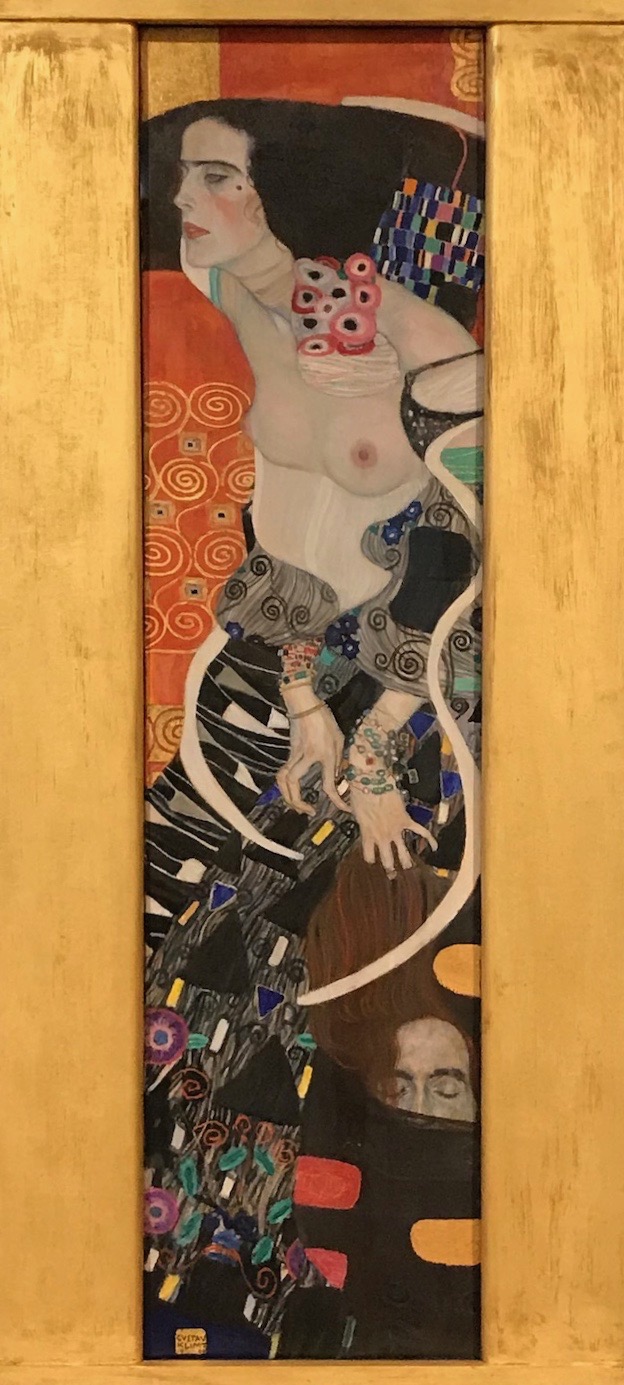
Finally!! I Got to See Klimt's Judith II


This was a twenty-year epic struggle for me. Okay, I exaggerate -- but the twenty-year part is true.

Since the late 1990s I've been fortunate enough to view most of the important paintings by Gustav Klimt. But one eluded me. It was the second of his paintings dealing with the Biblical subject Judith beheading Holofernes.

The painting is housed in Venice's Ca' Pesaro museum located on the Grand Canal, but not close to the main tourist zones.

The first time I visited Venice, in the late 1990s, the museum was undergoing renovation and so the painting was inaccessible. My second visit was while on a bus tour with my late wife, and I could not fit visiting it due to all the tour group activities. I was on a cruise the third time I got to Venice. But arrival was delayed until early afternoon due to heavy fog, so I simply hung out in the tourist zone, having limited time available. About a week ago I arrived via another cruise ship and bought a one-day vaporetto pass that made getting to and from Ca' Pesaro easy. And, Happy Day!!, the painting was on display and not off on loan (unlikely, because it is perhaps the museum's most famous possession).

The image at the top of this post and most of those below were taken by me using an iPhone. Click on them to enlarge.

Gallery

Klimt's 1901 Judith I.

Image of Judith II (1909) found on the Internet.


As seen by my iPhone.

Lower part of painting featuring Holofernes.

Detail of Judith.

Monday, October 22, 2018

Seen at the Bristol Museum and Art Gallery

The tour bus arrived at the hotel soon enough for me to get my suitcase to my room and then quickly walk across town, arriving at the Bristol City Museum and Art Gallery about 35 minutes before its 5 p.m. closing. That gave me little time to check out the shop, get oriented to the somewhat confusing layout of the building, and still view some paintings of interest to me.

Below are some highlights from that short visit. Click on images to enlarge.

Gallery

The Departure of John and Sebastian Cabot from Bristol on Their First Voyage of Discovery, 1497 - by Ernest Board - 1906
I wrote about Board here, noting that this painting has interested my for a long time. It hangs in the entrance area of the museum and is covered by protective material that's reflective, preventing getting a decent photo of it. Seeing it in person was the main motivation for my visit.

The Delhi Durbar of 1903, The Governor's Procession or The State Entry - by Roderick MacKenzie - 1907
Directly opposite is this huge work depicting an aspect of the Empire at its zenith.

Detail of the above, photographed at the museum

Holidays - by Harry Watson - c. 1920

Detail of the above, photographed at the museum

The Mackerel Shawl - by Algernon Talmage - 1910
Its information plaque notes that Talmage mostly painted landscapes. Nevertheless, this is an eye-catching work.

Detail of the above, photographed at the museum

La belle dame sans merci - by Frank Dicksee - 1902

The Briar Rose - No. 3, The Garden Court (Bristol version) - by Edward Burne-Jones - c.1885-90
One of a series of four paintings crafted to fit in a room of the patron's house. It seems that Burne-Jones painted a second version of The Garden Court, as the museum does not have the original.

Above painting, photographed at the museum
The museum has above-average lighting, so my iPhone-based photos capture what I saw well. This painting was restored recently, so its colors are brighter than those in the previous, Web-based image of the Bristol painting.

The Guarded Bower - by Arthur Hughes - c. 1865
Hughes was associated with the Pre-Raphaelite movement.

Above painting photographed at the museum
It looks much better in its frame than in the previous, Interned-based image.