Monday, July 8, 2019

Another Alma-Tadema Painting Up Close

Sir Lawrence Alma-Tadema (1836-1912) was long neglected, but now some of his paintings are auctioned for tens of millions of dollars. I wrote about this in 2011 and discussed his miniaturist aspect here.

He painted both large and small works, but the small ones can fascinate due to the skill used to render small faces and tiny details so convincingly.

I recently came across one such painting in San Francisco's Legion of Honor museum. It is "A Coign of Vantage" (1895). The title might be translated as "A Vantage Nook" -- the word "Coign" referring to a corner. It's 64 cm (25.2 inches) high and 44.5 cm (17.5 inches) wide. This is small, but hardly tiny. Even so, the subjects depicted take up little space: a head in profile is about 5 cm (2 inches) across.

Below are an establishment photo and detail photo featuring the ladies' faces. Click on the images to enlarge considerably (if your screen is large).

Gallery


Thursday, July 4, 2019

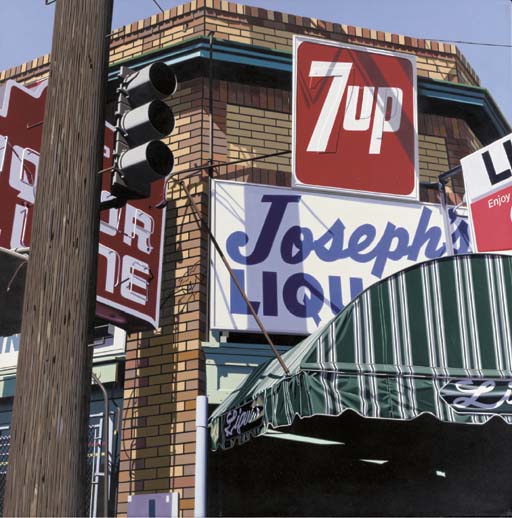
Robert Cottingham's Signs

A loyal reader (thanks, Bill) tipped me off to Robert Cottingham (born 1935) who is usually classed as a Photorealist.

His Wikipedia entry here is brief, and longer takes on him can be linked here and here.

Cottingham worked in advertising before taking up art full-time. Perhaps this commercial inclination led him to create many works in the form of prints of various types that might offer greater overall sales potential than paintings. (As I often state, if one's an artist, it's best not to be a starving one.)

I find it interesting that Cottingham has worked in a large variety of media, both in painting and printmaking. Even more interesting is that, when reduced to the small size of Internet images, it can be difficult to judge how they were made: they nearly all have a similar feeling.

One possible downside to his choice of subject matter is that a hundred and more years from now those subjects might well be puzzling to viewers due to their likely unfamiliarity.

But for us, they can be fun to see.

Gallery

Empire (oil on canvas) - 2012

Empire (serigraph)
Two images, different media.

Star Suite, Nite (print)

Art (sikscreen) - 2009

Fox (print) - 1973

Santa Fe (woodcut on paper)

11th Street (acrylic on canvas) - 1982

Joseph's Liquors (oil on canvas) - 1981

Bar Cabaret (watercolor) - 2014

Wichita (gouache on paper) - 1985

Lynn's Portable (woodcut) - 2004
Cottingham also does images of typewriters and old cameras.

Monday, July 1, 2019

John Marshall Gamble's California with Many Flowers

John Marshall Gamble (1863-1957) was what we call a California Impressionist, one of a group of artists who painted landscapes in various parts of that state, mostly over the years 1900-1930.

Gamble seems to have had a successful career, but was not one of the core group of California Impressionists. I justify that claim because after the 1906 San Francisco fire he was based mostly in Santa Barbara, slightly off the California Impressionist beaten track. Biographical information can be found here and here.

It seems that Gamble nearly always included wildflowers in his paintings, a feature that became something of a trademark. His paintings sold well, buyers coming from across the USA until the late 1930s when his eyesight began to fail.

Regarding his inclusion of flowers, the first link above states:

"When questioned by an interviewer about his passion for floral painting, he replied: 'I never painted them as flowers at all. I didn't even think of them as flowers while I was painting. They were just color patches to me, I simply liked the way they designed themselves across the field'. Many stolid Easterners considered his paintings pure fabrications, however when they made the trip to California's countryside in springtime the doubters were always proven wrong."

True, he didn't do close-up portraits of flowers. And it's also so that they add interest to the paintings in terms of composition and color schemes. But I also think he included those swathes of flowers because they helped make his paintings more marketable. Nothing wrong with that -- I'd rather an artist be prosperous than starving.

Also, as can be seen below, Gamble relied on several well-tested compositions for his California scenes.

Gallery

A Spring Morning, Poppies and Bush Lupine - c. 1915
This is the only dated (sort of) painting I downloaded.

Coastal scene
I don't have this painting's actual title, if it ever had one.

Poppies And Yellow Lupine, Point Lobos
Note the similarity of the hillsides in these scenes of different part of the state.

Wild Heliotrope near Laguna Beach

Wild Heliotrope near San Juan Capistrano
Again, two similar looking works.

Wild Lilac and Poppies

Wild Mustard and Radish
Hillsides sloping down to the right, but with different kinds of flowers.

Lupine, Del Monte Dunes
This has blockier brushwork.  I'm not sure if it: (1) is a study, (2) is small, or (3) was painted when his eyesight started to go.

The Dunes
Same general location, similar brushwork.

Twilight, Hope Ranch, Santa Barbara
This painting is quite different from the rest, and I'm not sure why.  I have friends who live in Hope Range (nowadays a very upscale housing area) and have walked near where this painting was made.  The view is toward the west.  That low-lying coast takes in perhaps part of Goleta where the airport and University of California Santa Barbara are, and definitely shows the coastline farther west of there, but not the high inland hills.

Thursday, June 27, 2019

Roger de La Fresnaye, Borderline Cubist

Roger de La Fresnaye (1885-1925) paintings are in the collections of New York's Metropolitan Museum of Art and the Museum of Modern Art, the National Gallery in Washington DC, and a number of museums in France.

Yet he is comparatively unknown. His Wikipedia entry in English is brief, as are similar entries in French and Italian. Little more was gleaned from a four-page Google search.

The link above mentions that he had a good deal of training in art, both conventional and modernist. Various sources offer various categorization of his style such as Expressionist, Fauvist, Cubist, Symbolist, etc. To me, asked to select a single type, I'd call him a Cubist during his most prolific period. But his cubism was superficial compared to that of, say, Picasso.

La Fresnaye's career was cut short by the tuberculosis he caught while serving in the Great War. The Wikipedia entry mentions that, postwar, the disease greatly hampered his productivity.

Gallery

Autoportrait - 1905

Alice lisant - 1907

Alice in a Large Hat - 1912
Two versions of Alice, whoever she might have been, at different points in his career.

Landscape at Ferté-Sous-Jouarre, Final Version - 1911
Cubist-lite construction, Fauvist-lite colors. The subject is a town by the Marne River that has been associated with battles and the military for many years. During the 1939-1940 campaign it was the headquarters of General Georges, who was in charge of operations in northeastern France. I drove through it once on the way to Château-Thierry. Yes, it's hilly there.

View of Florence - 1911
Here La Fresnaye seems to be experimenting with square-brush technique.

Artillerie - 1911
Pre- Great War painting. His father was an army officer. Available sources do not indicate whether La Fresnaye was conscripted or was commissioned when he was about age 20 and then was in the reserves until the war -- one or the other was likely. In any case, he was familiar with the army and painted some military subjects.

Cruirassier - 1912
Another military subject, a cavalryman.

Jeanne d'Arc - 1912

Baigneurs - 1912
Perhaps his best-known work.

Study for Couple with Greyhound - c.1913
Note the squaring. La Fresnaye clearly constructed some of his paintings carefully.

La Conquête de l'air (The Conquest of the Air) - 1913
A painting of the artist and his brother with a balloon shown in the upper left part of the canvas.

The Romanian - 1921
Postwar, La Fresnaye's style because more conventional in line with what other modernist were doing.

Guynemer
Georges Guynemer who died in 1917 was one of France's most famous Great War aces.

Entrance to the La Fresnaye Villa in Grasse - 1923-24
Although La Fesnaye was from northern France, this property is near Nice.

Monday, June 24, 2019

Charles H. Hubbell: Aviation Art from Late 1940s

Charles H. Hubbell (1898-1971) was an illustrator specializing in depicting aircraft. He is probably best known for his calendar illustrations for Thompson Products, a series that lasted for around 30 years.

Biographical information on Hubbell is sparse on the Internet. Sketchy sources are here and here.

As I've probably mentioned elsewhere, possibly years ago on the 2Blowhards blog and probably here on Art Contrarian, professional aviation art tends to be torn between two approaches. One approach is to meticulously depict an aircraft, perhaps even to the point of showing rivets on the metal (if there were any on the actual airplane). This tends to please a certain breed of airplane fan who expect the illustration to show everything. The other approach tends toward somewhat painterly, somewhat impressionistic views of aircraft. Here planes are depicted correctly in terms of their dimensions and the perspective from which they are viewed. But details are more selectively chosen, usually with one area in tighter focus in the way humans actually see things. Hubbell leaned towards the latter approach, though his skill level fell short of later aviation artists such as R.G. Smith, who I mentioned here.

Below are examples of Hubbell's work. Most or all are from those calendars, and most were probably painted 1946-1949.  The first five Great War images from the 1947 calendar are those I viewed on my bedroom wall when I was young, my dad having obtained one of those calendars.

Gallery

This shows some American Army DH-4 reconnaissance bombers under attack.

Balloon busting by a Royal Flying Corps S.E.5. This was far more dangerous than it looks because observation balloons were normally heavily defended by anti-aircraft guns.

Canadian ace Billy Bishop is shown downing what looks to be an Albatross.

America's top ace Eddie Rickenbacker in action.

The final seconds of Manfred von Richtofen's life. Whether the Red Baron was shot down by a fighter or by ground fire can never be resolved, so Hubbell includes both possibilities in this illustration.

Army Air Corps P-26 "Peashooters," active in the early/mid 1930s. Theories vary, but I am convinced that unofficial nickname was due to the long, peashooter-like gunsight.

Print showing early U.S. Army P-38 fighters with markings current from around mid-1942 to mid-1943.

A 1950 image showing the XF7U-1 Cutlass Navy fighter. The prototype Cutlass was an exciting-looking aircraft (though here Hubbell makes it slightly more graceful than it was), but went through a long, troubled development.

Another 1950 illustration, this of the F-86 Sabre that was entering service about that time.  The Sabre's fuselage is subtly shaped and not easy to depict. Hubbell's version is not realistic, perhaps because he might not have had enough useful reference photos.

Thursday, June 20, 2019

Anselm Feuerbach, Classicist and More

Anselm Feuerbach (1829-1880) died aged 50 after a life where he never lived in any one place for more than a few years. His career began around the time that some artists in Paris and the first Italian Macchiaioli began the first stirrings of proto-Modernism. Perhaps aware of this, even though his major works were Classical, Feuerbach's lesser or more casual paintings would be loosely done. This source has him "working in a Romantic style of Classicism."

Wikipedia's English link is here, containing a fair amount of biographical detail. The German site is comparable, though the French and Italian sites are sketchy..

Feuerbach still seems to be well-regarded in Germany where his paintings can be found in major museums. Seattle's Frye Art Museum has a few examples of his work, and the "Old Woman Seated" painting shown below is at the Norton Simon in Pasadena, California.

Gallery

Die Römer der Verfallzeit (Romans of the Decadence) - c. 1850
This early study is in the Frye collection, thought I don't recall having seen it displayed.

Hafis vor der Schenke (Hafiz in His Cups) - 1852
Wikipedia calls this "his first masterpiece." It was painted in Paris.

Self-Portrait - 1852
Feuerbach painted several self-portraits around that time, this being the most dramatic.

Old Woman Seated - 1853
A nice study, not at all Classical.

Nanna (Anna Risi) - 1861
She was his model in Italy for several years. His painting Ruhende Nymphe (Peaceful Nymph), a nude work that's not office-safe looks like it might be her, but is listed as a 1870 work -- probably after their relationship.

Henrirtte Feuerbach (his step-mother) - 1867
She was a strong supporter of Feuerbach.

Gastmahl des Plato (Plato's Symposium) - 1869
A major painting. The German title might also be translated as "Plato's Banquet" (Austrain dialect).

Medea with the Urn - 1873

Titanensturz (Fall of the Titans) - c. 1875
The first biographical link above, in reference to this ceiling painting, states: "In 1873 Feuerbach became a professor at the Vienna Academy of Fine Arts and painted for the academy building Fall of the Titans, generally regarded as his weakest work. Ill and discouraged by the harsh criticism of this work, Feuerbach left Vienna in 1876 and returned to Italy, where he died."