Note to regular readers:
I have written more than 1,500 Art Contrarian posts since 2010. I am about to turn 84 years old, and no longer follow the art world except casually. That means I'm finding it difficult to come up with topics for posts. Besides, I've said most of what I want to say on the subject.
So, rather than posting to a fixed schedule, I've decided to post whenever I feel the need to do so, much like David Apatoff does for his excellent Illustration Art blog.
Besides the occasional blogging here, I'll continue to post regularly on my Car Style Critic blog that deals with automobile styling and history, subjects I follow closely.
Thank you for your interest in Art Contrarian.
Monday, October 16, 2023

Monday, October 9, 2023
More Konstantin Korovin Paintings
I last wrote about Konstantin Alekseyevich Korovin (1861-1939) here. His Wikipedia entry is here.
He painted in a painterly (visible brushstroke), Impressionist style both in the Russian phase of his career and later in France.
As I mentioned in the earlier post, he carries this further that I prefer. This is best for landscapes, but the first portrait shown below works well when not seen enlarged (as you can do by clicking on it if you're viewing this on a desktop computer or possibly on a laptop).
All that said, Korovin's works were often pleasing and interesting.
Gallery
 Portrait of Mariinsky Theatre singer Vera Aleekseevna Dorofeeva - 1920
It isn't easy to do a convincing portrait of a young woman using strong brushwork, but Korovin succeeded here.
 Z. Pertseva - 1921
Perhaps due to it being nearly a full-figure work, his sketchy approach is less effective on Pertseva.
 Gourzouf - 1914
Russian Empire resort town.
 Gurzuf - 1915
Different transliterations from the Cyrillic, same place in Crimea the following summer.
 Moscow - 1914
The Kremlin is at the left, St. Basil's Cathedral is above the streetcar on the bridge over the Moskva River.
 French Port in Summer
Another summer resort painting in the 1920s or 1930s.
He painted in a painterly (visible brushstroke), Impressionist style both in the Russian phase of his career and later in France.
As I mentioned in the earlier post, he carries this further that I prefer. This is best for landscapes, but the first portrait shown below works well when not seen enlarged (as you can do by clicking on it if you're viewing this on a desktop computer or possibly on a laptop).
All that said, Korovin's works were often pleasing and interesting.

It isn't easy to do a convincing portrait of a young woman using strong brushwork, but Korovin succeeded here.

Perhaps due to it being nearly a full-figure work, his sketchy approach is less effective on Pertseva.

Russian Empire resort town.

Different transliterations from the Cyrillic, same place in Crimea the following summer.

The Kremlin is at the left, St. Basil's Cathedral is above the streetcar on the bridge over the Moskva River.

Another summer resort painting in the 1920s or 1930s.
Monday, October 2, 2023
Didier Graffet, French Steampunk Illustrator
Didier Graffet, born 1970, is a French painter/illustrator specializing in Steampunk and fantasy subjects. Some background regarding him is here.
As best I can tell, most artists of that genre nowadays produce digital images. Graffet, however, seems to have mostly or entirely painted using acrylics. That is more laborious than digital, given the amount and type of detail he uses. But the result is something tangible that can be sold for a good price, if auction values for some of his works are any clue.
Below are examples of his paintings found on the Internet.
Gallery
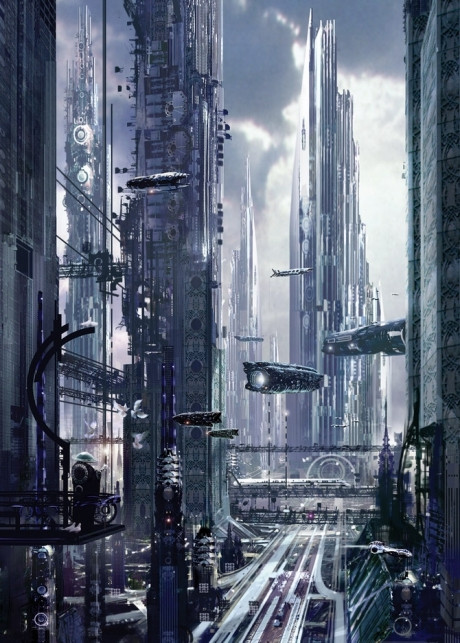 Angel City
First, to place Graffet's work in context, a fine example of digital Steampunk art by the well-known Stephan Martinière.
 A New York City fantasy by Graffet. He compresses Broadway, showing the 23rd Street's Flatiron Building (slightly altered) in the middle ground and Times Square closer in.
.jpg) Detail of the previous image. The Paramount Theatre at the right is in the same spirit as the actual Paramount of the late 1920s. The nearest southbound car is a Jaray-type streamlined Maybach of 1935. Other cars seem to be Graffet's inventions, as is the double deck bus at the left.
Detail of the previous image. The Paramount Theatre at the right is in the same spirit as the actual Paramount of the late 1920s. The nearest southbound car is a Jaray-type streamlined Maybach of 1935. Other cars seem to be Graffet's inventions, as is the double deck bus at the left.
 A country scene with castles in the background and Viking-type ships approaching us.
 Graffet used that vehicle's shape in several of his paintings.
 Here one is at a loading platform. The people on the balcony are dressed in circa-1920 fashion.
 Trafalgar Celebration
Trafalgar Square, London. HMS Victory sits by Nelson's monument while a huge dirigible loiters overhead. The people are dressed as in the 1890s.
 Métro Gare du Nord
The train station for points north of Paris. The façade is there, but far, far above street level. The sign fragment at the upper left advertises trains for London.
 Le Tour
Eiffel Tower as seen from across the Seine. Some of the airships are steam powered, highly unlikely in reality, but found in Steampunk illustrations by other artists.
As best I can tell, most artists of that genre nowadays produce digital images. Graffet, however, seems to have mostly or entirely painted using acrylics. That is more laborious than digital, given the amount and type of detail he uses. But the result is something tangible that can be sold for a good price, if auction values for some of his works are any clue.
Below are examples of his paintings found on the Internet.
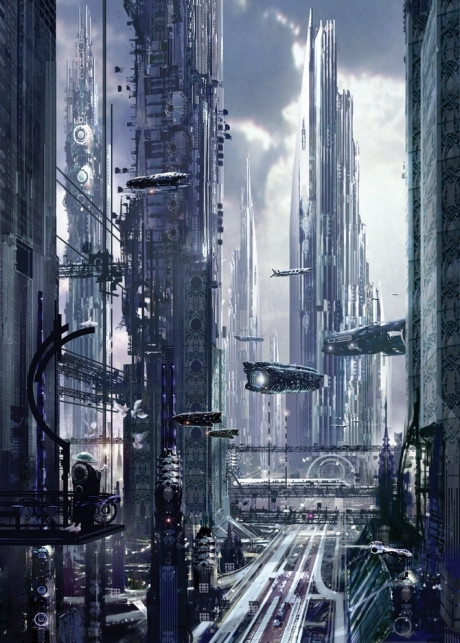
First, to place Graffet's work in context, a fine example of digital Steampunk art by the well-known Stephan Martinière.

.jpg)


Trafalgar Square, London. HMS Victory sits by Nelson's monument while a huge dirigible loiters overhead. The people are dressed as in the 1890s.

The train station for points north of Paris. The façade is there, but far, far above street level. The sign fragment at the upper left advertises trains for London.

Eiffel Tower as seen from across the Seine. Some of the airships are steam powered, highly unlikely in reality, but found in Steampunk illustrations by other artists.
Monday, September 25, 2023
Anastasia Vostrezova, Painter of the Ballet
Anastasia Vostrezova, born 1981, is a Russian representational painter known for her depictions of ballet dancers. A brief biographical note is here, and more information is here.
Vostrezova is skilled, her paintings generally being well composed and pleasingly executed. That said, she also seems to have an eye on the mid-level art market that likes professionally-done, but not profound paintings featuring people.
Gallery
 Self-Portrait in a Hat
 Self-Portrait in a Theater Costume
A pastel work.
 Now for a few ballet-related paintings.


 The Old Buffet
As best I can tell from images of her paintings found using Internet searches, her subjects are always women.
 The Antique Shawl
Note the variation is brushwork between the subject and dress/background.
Vostrezova is skilled, her paintings generally being well composed and pleasingly executed. That said, she also seems to have an eye on the mid-level art market that likes professionally-done, but not profound paintings featuring people.


A pastel work.


As best I can tell from images of her paintings found using Internet searches, her subjects are always women.

Note the variation is brushwork between the subject and dress/background.
Monday, September 18, 2023
Bartow Van Voorhis Matteson - 1920s Illustrator
Bartow Van Voorhis Matteson (1894-1984) was an illustrator active in the 1920s who might have transitioned to Fine Arts later during his long life. I can find virtually no biographical details about him on Google and Bing searches or in my reference library.
Below are some examples of his illustration work, most from the 1920s. Some are competently done, and appeared in some of the better magazines. A few others are of lesser quality.
Gallery
 U.S. Army Medical Department poster - c.1918
Matteron signed this as an Army lieutenant. I don't think this poster is well-done artistically and persuasively.
 Vignette format Western romance scene
Matteson did a number of Western romance story illustrations. This is not his best: note the poor anatomy at the man's neck and shoulder.
 Farm scene
Story illustration.
 The Courtship
Another Cowboy romance. Essentially the same costume as seen above. The girl is nicely depicted.
 Under the Moonlight
From the same story as the preceding image? Costumes are nearly the same. Or did Matteson simply repeat the same sort of clothing again and again when called to do Western love stories?
 Gypsies Paused at the Clearing
This is comparable to 1920s illustrations by better-known artists such as Dean Cornwell.
 Heartache at Sea
Another competent work.
 Lovers and swans scene - The Country Gentleman magazine - 1926
For reasons of printing economy in those days, many illustrations were created and printed in duotone.
 The Proposal - 1930
The lady is poorly drawn: her head is too large for her body.
Below are some examples of his illustration work, most from the 1920s. Some are competently done, and appeared in some of the better magazines. A few others are of lesser quality.

Matteron signed this as an Army lieutenant. I don't think this poster is well-done artistically and persuasively.

Matteson did a number of Western romance story illustrations. This is not his best: note the poor anatomy at the man's neck and shoulder.

Story illustration.

Another Cowboy romance. Essentially the same costume as seen above. The girl is nicely depicted.

From the same story as the preceding image? Costumes are nearly the same. Or did Matteson simply repeat the same sort of clothing again and again when called to do Western love stories?

This is comparable to 1920s illustrations by better-known artists such as Dean Cornwell.

Another competent work.

For reasons of printing economy in those days, many illustrations were created and printed in duotone.

The lady is poorly drawn: her head is too large for her body.
Monday, September 11, 2023
George Frederic Watts: Some Portraits
George Frederic Watts (1817-1904) was an important 19th century British artist, as is noted here.
Among many other things, that Wikipedia entry mentions: "He was also admired as a portrait painter. His portraits were of the most important men and women of the day, intended to form a 'House of Fame'. In his portraits Watts sought to create a tension between disciplined stability and the power of action. He was also notable for emphasising the signs of strain and wear on his sitter's faces. Of his British subjects many are now in the collection of the National Portrait Gallery..."
Today's post presents several of those portraits from 1864 through 1871, a period when many of them were painted.
Shown are mostly art- and culture-related personalities, subjects apparently dear to Watts' heart, as he was part of that tribe. Artistically, they are accurate from a representational standpoint. They are rather dark, brownish -- an appearance that was fashionable in late-1800s Britain, as a visitor to London's National Portray Gallery will notice.
Gallery
 Giuseppe Garibaldi - 1864
Garibaldi was a political figure thanks to his effort to unity Italy. But that also made him a figure of popular culture -- there's even a mountain named after him in far-off British Columbia.
 Ellen Terry in "Choosing" - 1864
Watts was briefly married to this famous actress. She ran out on him.
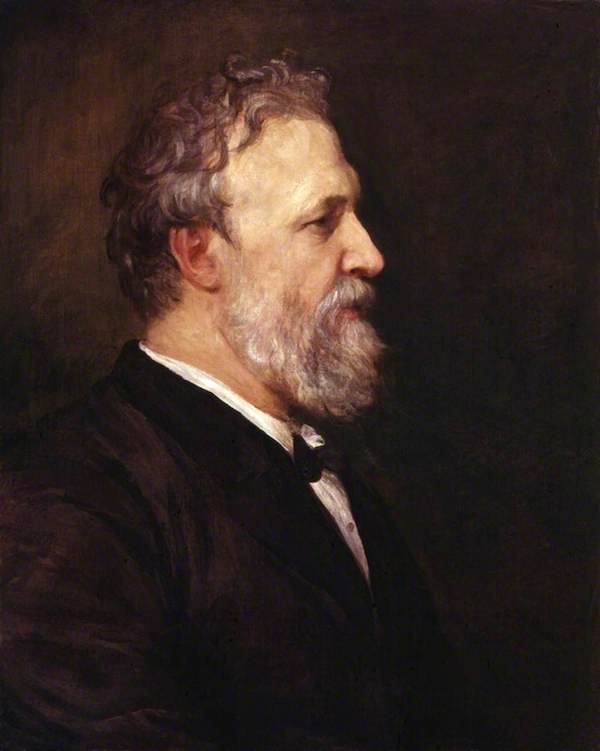 Robert Browning - 1866
The poet.
 Algernon Charles Swinburne - 1867
Another poet.
 Florence Nightingale - 1868
The famous nurse of the Crimean War.
 Daniel Gabriel Rossetti - 1870
Pre-Raphaelite painter.
 William Morris - 1870
Arts and Crafts movement personality.
 Frederic Leighton - 1871
Famous painter.
 Edward Millais - 1871
Pre-Raphaelite painter.
Among many other things, that Wikipedia entry mentions: "He was also admired as a portrait painter. His portraits were of the most important men and women of the day, intended to form a 'House of Fame'. In his portraits Watts sought to create a tension between disciplined stability and the power of action. He was also notable for emphasising the signs of strain and wear on his sitter's faces. Of his British subjects many are now in the collection of the National Portrait Gallery..."
Today's post presents several of those portraits from 1864 through 1871, a period when many of them were painted.
Shown are mostly art- and culture-related personalities, subjects apparently dear to Watts' heart, as he was part of that tribe. Artistically, they are accurate from a representational standpoint. They are rather dark, brownish -- an appearance that was fashionable in late-1800s Britain, as a visitor to London's National Portray Gallery will notice.

Garibaldi was a political figure thanks to his effort to unity Italy. But that also made him a figure of popular culture -- there's even a mountain named after him in far-off British Columbia.

Watts was briefly married to this famous actress. She ran out on him.

The poet.

Another poet.

The famous nurse of the Crimean War.

Pre-Raphaelite painter.

Arts and Crafts movement personality.

Famous painter.

Pre-Raphaelite painter.
Monday, September 4, 2023
Edwin Lord Weeks, American Orientalist
Edwin Lord Weeks (1849 – 1903) had wealthy parents and so was able to study art and visit exotic places. His Wikipedia entry notes:
"In 1872 Weeks relocated to Paris, becoming a pupil of Léon Bonnat and Jean-Léon Gérôme.
After his studies in Paris, Weeks emerged as one of America's major painters of Orientalist subjects. Throughout his adult life he was an inveterate traveler and journeyed to South America (1869), Egypt and Persia (1870), Morocco (frequently between 1872 and 1878), and India (1882–83)."
Orientalism was a fasionalble painting genre in the last three decades of the 1800s. Typical subject matter was the Middle East, though French orientalists often favored scenes from France's North African empire thanks to its convenience. Weeks' teacher Gérôme is an important example.
British and the fewer American orientalists often cast a wider geographical net, taking in Turkey and British Empire locations as well are places of British influence such as Egypt and Persia.
So it was with Weeks, as noted above. Many of the scenes in the Gallery below are set in India, some in Persia, and others in unidentified locations (though a scholar of costumes and architecture could probably make a close guess).
Weeks had a strong representational style and was highly productive over a comparatively short 30-year career.
Gallery
 The Temple and Tank of Walkeschwar, Bombay
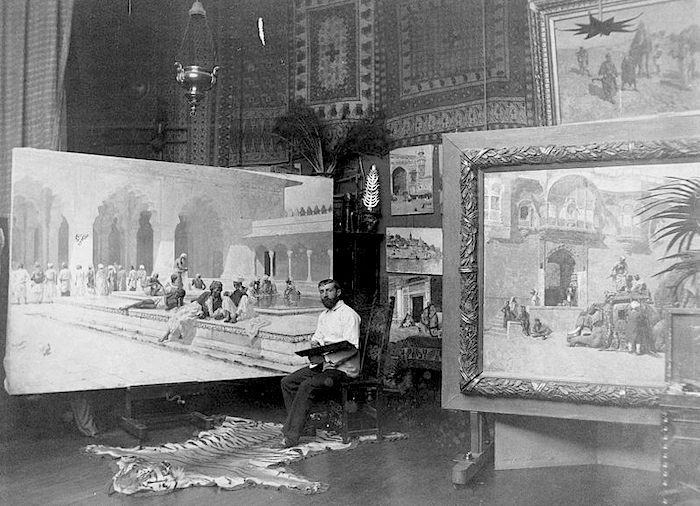 Photo: Weeks in his studio
Note the size of some of his works.
 Along the Ghats, Mathura
 Perfumer's Shop, Bombay
 Horses of the Ford - Persia
 La princess de Bengale
 Persian Café - The Pottery Seller
 Street Scene in India
"In 1872 Weeks relocated to Paris, becoming a pupil of Léon Bonnat and Jean-Léon Gérôme.
After his studies in Paris, Weeks emerged as one of America's major painters of Orientalist subjects. Throughout his adult life he was an inveterate traveler and journeyed to South America (1869), Egypt and Persia (1870), Morocco (frequently between 1872 and 1878), and India (1882–83)."
Orientalism was a fasionalble painting genre in the last three decades of the 1800s. Typical subject matter was the Middle East, though French orientalists often favored scenes from France's North African empire thanks to its convenience. Weeks' teacher Gérôme is an important example.
British and the fewer American orientalists often cast a wider geographical net, taking in Turkey and British Empire locations as well are places of British influence such as Egypt and Persia.
So it was with Weeks, as noted above. Many of the scenes in the Gallery below are set in India, some in Persia, and others in unidentified locations (though a scholar of costumes and architecture could probably make a close guess).
Weeks had a strong representational style and was highly productive over a comparatively short 30-year career.

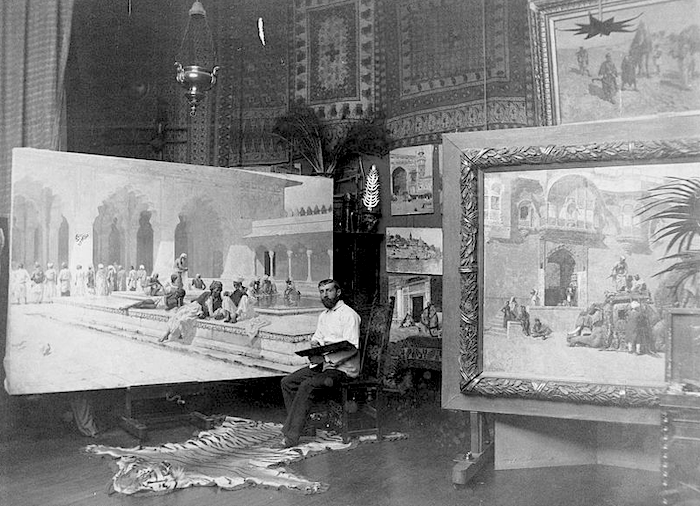
Note the size of some of his works.


Subscribe to:
Posts (Atom)