Thursday, December 6, 2018

Louis Denis-Valvérane the Painter Who Also Was Vald'Es the Cartoonist

Louis Denis-Valvérane (1870-1943) was a Provençal painter and illustrator/cartoonist who is perhaps best known for his racy (at the time) cartoons in the magazine La vie Parisienne that he signed as Vald'Es.

Biographical information on him is almost non-existent on the Internet. Very brief items are here and here. A web site devoted to him is here. It is in French and contains a little more information, but mostly mentions aspects of Provençal nationalism.

Denis-Valvérane's paintings found on the Web tend to be somewhat mediocre in my opinion, but some of his cartoon work strikes me as being very good. Examples of each are shown below.

Gallery

Notre Dame du Romigier, Mairie de Manosque
A scene from Denis-Valvérane's home town.

Traveuax des champs - Working the Fields

Young Woman Reading a Letter to a Blind Man
The man's shirt and hands are done well.

Sailing Boats

Apparently it was expected in La vie Parisienne that it was good to show some female thigh above the stocking.

But that wasn't mandatory.

Hinting was also acceptable.

Flapper and apparent Sugar Daddy.


A two-part cartoon about young French women in the Roaring Twenties.

I like this one. Well-drawn, witty. Click on it to enlarge.

Monday, December 3, 2018

New Book About Haddon Sundblom

Haddon Sundblom (1899-1976) was a leading illustrator for many years and influential in the careers of other illustrators.


Now Dan Zimmer of Illustration Magazine has written a lavishly illustrated book about him (information here). I am quite pleased with it. Some books on illustrators lack details regarding their subjects because illustrators, like many writers, can live somewhat isolated lives due to the nature of their work. Sundblom ran a commercial art studio in Chicago, so there were many people around him that could provide stories. Also, he was quoted in interviews, which helped Zimmer to provide a more rounded portrait than he was able to do in some other cases.

For a quick take on Sundblom, his Wikipedia entry is here.

I posted about him here on 27 February 2012 and here on 8 June 2011. In the latter post, I stated:

"Yet something bothers me just enough that I can't place Sundblom with contemporaries such as Dean Cormwell, John La Gatta and Mead Schaeffer. Maybe it had to do with stereotyping or pigeonholing by clients and art directors. Perhaps it was Sundblom's preference. In any event, the result was that little of his work had drama or "bite" of any kind."

Some of the illustrations in the book invalidate what I thought back in 2011. Sundblom was quite able to paint in styles other than the buttery sort that he is best known for. Some examples are below.

Gallery

Sundblom is best-known nowadays for his depictions of Santa Claus for Coca-Cola. This example is from 1946.

He did a good deal of other work for Coke, such as this 1950 poster.

Coca-Cola illustration from 1937. Again in his buttery oil-painting style.

Red Cross theme poster art.

Now for some editorial art for fiction pieces in magazines: this seems to be from the late 1930s.

From a June, 1957 Ladies' Home Journal.

Now for some illustrations that are not "buttery."


These three images represent top-quality 1930s-vintage magazine illustration, and are far removed from Sundblom's Coca-Cola work.

Finally, a Sundblom story illustration demonstrating his ability to depict ordinary folks, and not glamorous or dramatic types.

Haddon Sundblom was really good.

Thursday, November 29, 2018

Edwin Davenport: An Illustrator Whose Career Seemed to Peak Around 1927

Biographical information for the illustrator Edmund Davenport must be someplace, but I can't seem to find it by Googling. Nor can I find it in my personal collection of books about illustration.

All I know for sure at this point is that most of the internet images of his work date from 1925-1928. These works include some Saturday Evening Post covers, so Davenport briefly was hitting the big time.

Besides the Post, he did covers for other magazines and advertising art for Stutz automobiles and Syracuse China (the latter not shown below).

Here are most of the examples of his work that I could find.

Gallery

Saturday Evening Post cover - 13 June 1925
New graduate literally "on top of the world."

Holland's Magazine cover - May 1926

The Elks Magazine cover - February 1926
The Elks are an American fraternal organization.

American Magazine cover - November 1928

Stutz advertisement - 1927
This advertisement and the ones below feature simplified backgrounds and contra-jour shading that serve to set off the images of the cars.

Stutz advertisement - 1927
Stutz is best remembered for its Stutz Bearcat sports cars from the 1910s.

Stutz advertisement - 1927

Stutz advertisement - 1927

Stutz advertisement - 1927
A black & white ad, but the artwork might have been done in color like the ones shown above (though the contra-jour is missing, suggesting it was done in b&w) .

Monday, November 26, 2018

Lionel-Noël Royer, French Painter of History


Lionel-Noël Royer (1852-1926), according to his English language Wikipedia entry, is best known for his large paintings of the life of Joan of Arc located in the Basilica of Bois-Chenu in Domrémy, her home town. His French Wikipedia entry also notes that he is known "ainsi que du tableau Vercingétorix jette ses armes aux pieds de Jules César." The latter ("Vercingétorix Throwing his Weapons at the Feet of Caesar" - 1899) is probably better known outside France because it has been used as book cover art. It's the image at the top of this post (click on it to enlarge).

Royer fought in one Franco-Prussian War battle, so was qualified to paint battle scenes even though he followed convention and overly dramatized the action.  Following the war he studied art at l'École des beaux-arts de Paris under Alexandre Cabanel and William Bouguereau.

Royer painted simple subjects, but excelled in dealing with complex scenes with casts worthy of a Cecil B. DeMille Biblical movie. Well, fewer people than in film crowd scenes, but plenty on artists' canvases.

Below are more examples of his work. But I have to say that I like the Julis Caesar painting best, even though the French link above states "Les historiens soulignent notamment le fait que Vercingétorix ne s'est certainement pas présenté en armes devant César au moment de sa reddition (il aurait été massacré par la garde romaine). Le cheval est à l'époque une monture romaine, les Gaulois utilisant plutôt des poneys (plus petits). Le tableau traduit surtout une volonté d'héroïser le personnage de Vercingétorix." That is, what Royer painted probably did not actually happen the way he depicted the surrender.

Gallery

Joan of Arc at the coronation of Charles VII at Reims
Click on the image to enlarge.

Bataille d'Auvour
Also known as the Battle of Mans, fought 10-12 January 1871.  A large but rag-tag French army was defeated by the Prussians. This battle, along with the end of the Siege of Paris a few days later, marked the end of the main military phase of the Franco-Prussian War

Le Lieutenant-Colonel Athanase de Charrette à la tête des Zouaves Pontificaux – Bataille de Mentana - 3 Novembre, 1867
This battle was between Garibaldi's Italians and an army comprised of the French and Papal Zouave troops. The Italians were defeated.

Marchande de Fleurs - The Flower Seller
The flower seller is at the lower right corner with her push-cart. At the lower left is a red automobile that dates the painting as from a few years around 1905. The large building is the Hôtel de Ville, Paris' city hall, and the tall structure at the right is the Notre-Dame.

The Muses Garden
The opposite of Royer's war paintings.

Allegory of Summer
Confirmation that he studied under Bouguereau.

Étude pour la figure de l'amour

Thursday, November 22, 2018

University of Bristol's Mills Tower

Most tours of England's West Country take in the city of Bath, that once was a Roman site and for many is a Jane Austen mecca. But not far down the road to the west is Bristol, which also is worth a visit, though its character is different.

Architecturally, and due to its siting, the Bristol building that interests me the most is the Wills Tower on the Wills Memorial Building. It sits on one of Bristol's hills as part of Bristol University, a "red brick" institution that received its royal charter in 1909.

The tower's construction was begun in 1915, but completion was delayed until 1925 due to the Great War. Its architect was Sir George Herbert Oatley (1863–1950) who was the university's architect for a number of years. It is a tall (215 foot, 65.5 meter) structure nicely composed using plain and highly decorated areas that play off one another.

Gallery

The tower as seen looking up Park Street in 1939 where it serves as a focus.

Park Street is just off to the right of this view that I took the last time I was in town. This street is Queens Road that becomes Park Row and heads downhill as it bends left beyond the edge of the photo. The building at the left is the Bristol Museum and Art Gallery that has some interesting paintings in its collection.

The massive corners have little decoration and the rest of the tower is quite Gothic.

Street level view.  A nice touch is the shields placed above the tall windows.

Monday, November 19, 2018

Pierre-Georges Jeanniot: From War to Salons

Pierre-Georges Jeanniot (1848–1934) fought in the Franco-Prussian war, later rising to the rank of Major. When offered promotion to commandant (lieutenant colonel), he resigned to become a full-time artist. From this Wikipedia entry, it isn't clear where he received artistic training, though the French version states it was from his father who for many years was director of l'École des Beaux-Arts of Dijon.

The entry also mentions that Jeanniot became friends with some of the French Impressionists, especially Edgar Degas. And in 1906 he became a chevalier (knight) of the Légion d'Honneur, then officier par décret in 1929. Clearly, he was well-regarded in his day, though not widely known today, at least here in the USA.

Besides painting, Jeanniot was an engraver and illustrator of books.

As can be seen in the images below, he was highly skilled, though his works were not distinctive enough (in my judgement) to be instantly identifiable as done by him.

Gallery

La Ligne de feu, épisode de la bataille du 16 Août 1870 - Firing Line, an Episode During the Battle of Mars-la-Tour, 16 August, 1870 - c. 1881

Réservistes de 1870 - Reservists During the Franco-Prussian War - 1882

Elèves caporaux sur l'esplanade des Invalides à Paris - Group of Trainees on the Esplanade of the Invalides, Paris - 1883

Une Élégante au Café - Elegant Woman in a Café - 1883 (pastel)

The Pink Camelia - 1897

Mélancolie

Une chanson de Gibert dans le salon de madame Madeleine Lemaire - A Song by Gibert in the Salon of Madame Madelaine Lemaire - 1891

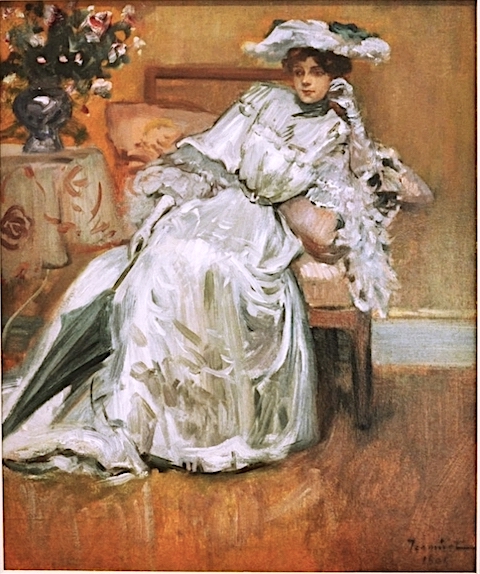
Élégante au salon - Elegant Lady at a Salon - 1905

Woman in Café - 1910

Portrait de Henriette assise avec un châle - Henriette Seated with a Shawl - 1926