Thursday, July 9, 2020

Some Gustav Klimt Drawings

Gustav Klimt (1862-1918) was never mentioned in the art history class I took many years ago. Now he is famous. That fame largely rests on his early 1900s "golden" period works such as "The Kiss," "Adela Block-Bauer," "Judith" and "Pallas Athene." His Wikipedia entry is here.

Klimt also made many drawings that have been preserved. They are mostly of women, a number of which are erotic. Some of the latter can be readily found on the Internet, but the selection below is of the safe-for-office-viewing variety.

The styles of his drawings tend to parallel those of the paintings he was making at about the same time. Those below are shown in approximate chronological order based of their styles.

Gallery


These first three drawings seem to be from the time Klimt's paintings were mostly conventional.

This was probably made in 1896 when his style began to move from conventionality.

He often put the greatest effort into faces.

Apparently a study for his 1902 Beethoven Frieze.

The signature block is the same as for the previous drawing.  The word nachlass refers to posthumous collection.

From his late period around the time of the Great War.

Another from that time.

Monday, July 6, 2020

Assortment of Arthur Mathews Paintings

Arthur Frank Mathews (1860-1945) was a California painter whose favored toned-down colors and, when dealing with people, mannered scenes. All of this was very much of his time and locale. I enjoy viewing his works, especially when I can see them in person.

I last wrote about Mathews here, and here is his Wikipedia entry.

The images below are some that I grabbed from my painting database. No theme in mind other than showing some of the variety of his production.

Gallery

The Grape - 1906
I've seen this several times in San Francisco's de Young Museum, but it might not be on permanent display.

California - 1905

Carmel
Mathews sometimes ventured to the nearby Monterey area as this and the following two painting attest.

Monterey Bay

Afternoon Among the Cypress - 1905
This might have been in the present 17-Mile Drive area of the Monterey Peninsula

The Wave - c. 1900
He dabbled in scenes of mermaids.

Woman and swan
Women were a favorite subject.

Thursday, July 2, 2020

Toby Rosenthal, American Expatriate

Toby Edward Rosenthal (1848-1917) was born in Connecticut, spent his youth in San Francisco, and then moved to Germany around age 17 where he apparently spent much of the rest of his life. Or so claims his Wikipedia entry.

His painting style was conventionally representational. Moreover, he was skilled at portraying settings -- details, lighting, coloring and the rest. Subject matter varied. Some scenes were serious while some others were humorous.

In sum, I find Rosenthal highly competent, yet hard to pin down compared to contemporaries whose individuality was stronger and more consistent over their careers.

Gallery

Woman with Parasol
I can't quite read the writing at the lower right, so will assume for now that this was from early in his career.

The Beautiful Elaine - 1874
Apparently this painting was well-received when it traveled to America.

He Who Laughs Last - 1876
The left half of a diptych, the other titled "Who Laughs Last" showing the young man at the right sprawled after slipping.

Nude Seen from Rear - c. 1880

Sleeping Cardinal (The Cardinal's Portrait) - 1896
An amusing scene. Note the skillful depiction of the setting's details.

View Through a Window, Landsberg, Germany - c. 1900
Not that it matters here, but the prison in Landsberg was where Hitler was jailed following the Munich "Beer Hall Putsch" and wrote "Main Kampf."

His Madonna - 1916
A late painting, still done in conventional style. Apparently Rosenthal was able to ignore Impressionism and all the modernist "isms" of the early 20th century.

Monday, June 29, 2020

Alaska Lithographs of Rie Muñoz

Rie Muñoz, née Marie Mounier (1921-2015) is known for lithographs of scenes from the Alaska Panhandle -- the part of the state's coastline the extends south with Canada's British Columbia province to its east. There are essentially no roads leading to Canada and the interior due to a large chain of mountains blocking the way. And there are few cities and towns there, Juneau, Ketchikan and Sita being the best known. The only means of getting from one to another is by boat or airplane.

Her brief Wikipedia entry is here and information on a web site devoted to her is here.

I'm now located near the cutesy-poo arty town of La Conner, Washington where one gallery features her lithographs. They are usually charming and nicely composed, though not being an Alaska fan, I am not tempted to buy one. (I grew up in Washington state back when its population was about a quarter of its now nearly eight million. In those days, even between larger cites such as Seattle, Tacoma and Everett there were plenty of forests and such. Western Washington is not as rugged as the Alaska Panhandle, but the same kind of elements were there. So Alaska is no big deal to me, and I've only been there once.)

The images below are copyrighted. However, they are much smaller than the original prints and only serve to acquaint readers with the artist's work -- examples of which can be purchased in galleries or online.

Gallery

Late Boat

Northern Lights, Juneau - 1992

Russians were the first Europeans to colonize Alaska, and remnants of that time (pre-1867) remain, such as this church.

Fish Buyer
People are nearly always depicted as being chunky.  To some degree this is because of the kinds of clothing Alaskans need to wear.  But those solid shapes also help in terms of a scene's composition and coloring.

Sorting Crabs

A town wedged against the mountains.

Probably the Juneau airport with people waiting for an Alaska Airlines flight to Seattle and points south.

Thursday, June 25, 2020

Jon Whitcomb's Cadillac Advertisement Illustrations

Jon Whitcomb (1906–1988) was famous for portraying beautiful, glamorous women in story illustrations and advertisements. Some background can be found here and here.

But for a few years in the late 1930s he had the plum assignment of illustrating Cadillac advertisements, a subject far from his signature work. Clearly, Whitcomb was more than a one-act-pony when it came to illustration.

Some of his Cadillac advertisements are shown below. Given that they include his signature, I have to conclude that he illustrated the cars as well as backgrounds, people and other details. However, I need to note that many automobile advertising images were produced by two artists, one specializing in rendering cars, the other depicting the setting. A well-known example is the series of Pontiac illustrations where Van Kaufman did the settings and Art Fitzpatrick the cars. On the other hand, Bernie Fuchs was able to deal with the whole package, as presumably Whitcomb did. (Let me know if I'm mistake regarding Whitcomb.)

Click on the images to enlarge.

Gallery

The kind of illustration Whitcomb was famous for.

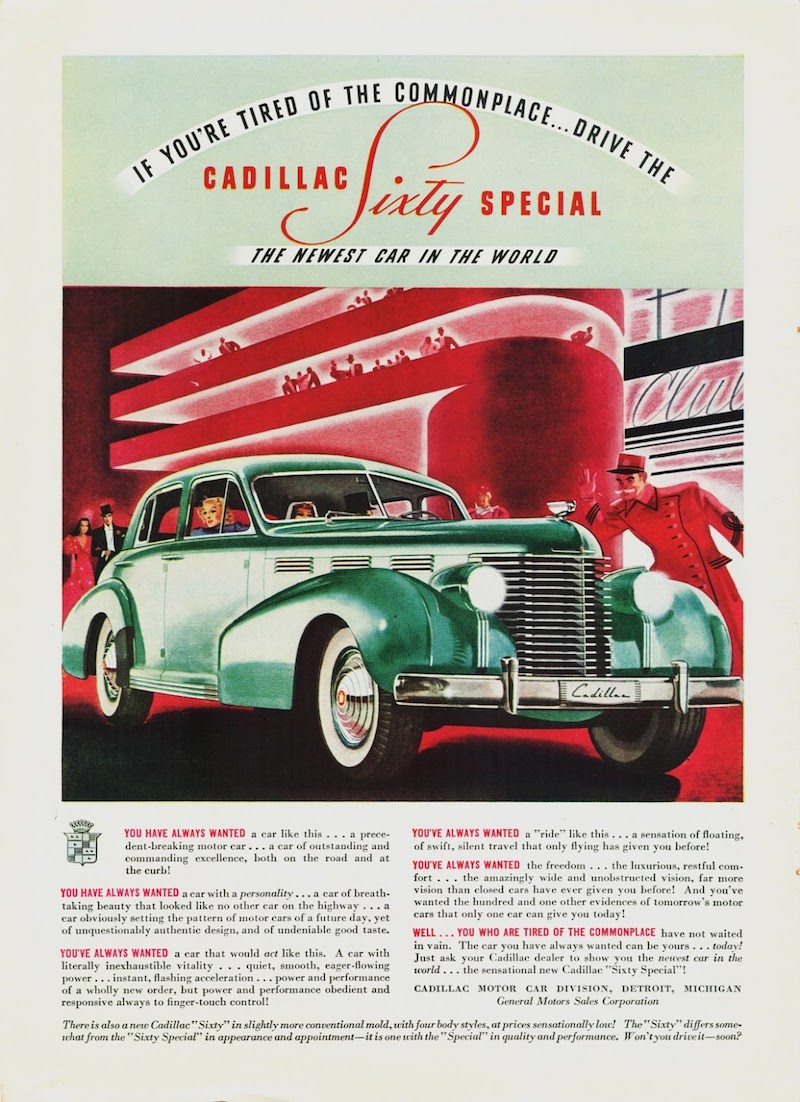
1940 Cadillac Sixty Special
Compare the car in this illustration to that in the photo below.

1938 Cadillac Sixty Special - Auctions America photo
This is what Sixty Specials looked like -- a classical-yet-sporty and distinctive body for its time.

1938 Cadillac Sixty Special
Most of the advertisements included here posed the cars in futuristic settings. Here the car's perspective is distorted and the passengers are shrunken so as to suggest that the car is huge. This was standard advertising practice from the late 1930s through the 1950s and perhaps beyond.

1938 Cadillac Sixty Special
Not a very futuristic background here.  The airplane seems to be a Pan American Airways Sikorsky S-42 that entered service back in 1934. On the other hand, the airbrush-like background offers a futuristic industrial design feeling.

1938 Cadillac Sixty Special
The shapes in the background hint at the Trylon and Perisphere theme structures of the forthcoming 1939 New York World's Fair.

1939 Cadillac Sixty-Two
Here we finally find some glamorous women that became Whitcomb's specialty.

1939 Cadillac Sixty Special
Another seaplane passenger liner in the background, but this one is an imaginary design.

1939 Cadillac Sixty Special
A domestic, yet Moderne setting. The man seems almost in proper scale (he is a door-width away from the car), but the woman is too small.

1939 Cadillac Sixty Special
Here Whitcomb loses his touch, seriously distorting the car's proportions.

1939 Cadillac Sixty Special
This Sixty Special is too short and the background isn't futuristic -- but more believable.

Monday, June 22, 2020

More Franz Bischoff Paintings

Nine years ago I wrote about Franz Bischoff (1864-1929), Wikipedia entry here.

As the links indicate, Austrian Empire born Bischoff did not start his career painting California scenes. Rather, he was originally best known as a porcelain decorator in the Midwestern USA before he moved to the Pacific Coast.

I selected what I considered the best examples of his work for the previous post. However, the images here are of interest.

Gallery

At Sunset
Bischoff did paint people, but apparently not often enough to become really good at it.

Arroyo Seco Bridge - c. 1915
This is a Pasadena, California scene not far from where the famous Rose Bowl football stadium was built.

Emerald Cove, Carmel
California's Carmel-by-the-Sea was an artist colony town even in the early 1900s.  Bischoff made many paintings of the area even though he lived near Los Angeles.

Picking Poppies - c. 1910
This is a more successful work that includes women.  That's because the brushwork he used for them is similar to that used in the rest of the painting, creating a more unified feeling.

Three Women at the Seashore
Something is wrong about the central woman's right arm.

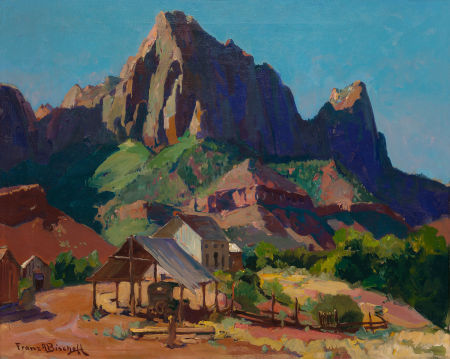
The Watchman, Zion National Park - c. 1925
One of his later nature paintings -- strongly done.

Villa on the Monterey Coast
The colors here are unusual for Bischoff, though that might have been dictated by the subject.  For what it's worth, I don't notice his signature.

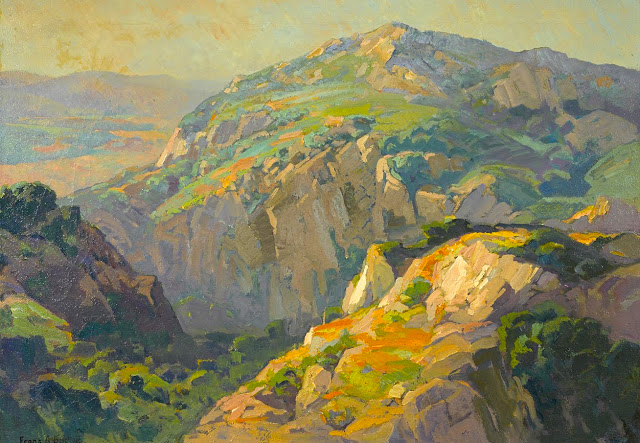
Canyon Green
A more typical Bischoff landscape.

Highland Drive, Monterey Coast
Another Carmel area scene, but south of town.