Showing posts with label Genres. Show all posts

Thursday, August 6, 2020

Georges Croegaert's Languorous Women and Off-Duty Cardinals

Georges Croegaert (1848-1923) was born in Antwerp and trained in art there. Then he moved to Paris where made his career. His Wikipedia entry is here.

These days his paintings can auction in the $15,000-$40,000 range, and apparently his career was successful. Rather than being avant-garde or painting strictly academic scenes, Croegaert seems to have settled into a groove of painting in genres popular with the art-buying public. In his case, these were images of attractive women in luxurious settings and pictures of Roman Catholic Cardinals in relaxed or informal settings.

Below are some examples of that variety of popular fare in the late 19th century and beyond.

Gallery

La lecture - 1890
This painting and the next three depict women reading.

A Good Read

Jeune femme lisant dans un intérieur japonisant - 1887

Leisure Hours

Reflections - 1886
Now for two paintings featuring women looking into mirrors.

The Mirror

Dreams of the Orient
A languorous lady in an Orientalist setting (Orientalism was another popular genre).

A Distinguished Visitor
Now a few Cardinals scenes.

A Church Legacy

Après le café

Monday, January 13, 2020

Hugh Breckenridge, Competent in Several Styles

Hugh H. Breckenridge (1870-1937) was a long-time instructor at the Pennsylvania Academy of the Fine Arts who had studied in Paris under the supreme realist William Bouguereau. A little background can be linked here.

I need to confess that I had never heard of Breckenridge until I stumbled across one of his paintings on the internet. Turns out that he was both versatile and did good work in a variety of genres: no one-trick pony he.

Below are examples of most of the genres he worked in. I think he was especially good using bold compositions and bold colors.

Gallery

The White Vase
I don't have a date for this, but will assume for now that it's not a late painting.

Moon Shadows (Nocturne) - 1899
Reminds me of California Impressionist Charles Rollo Peters' work.

A Thread of Scarlet - c. 1905
Now for some conventional portraits ...

Georgine Shillard-Smith - c. 1909
Here is a "highly finished" painting.

Blue and Gold - c. 1916
A few years later, this portrait is still representational, but the color scheme has a whisper of Fauvism.

The Lake - 1916
Philadelphia was quite art-conscious in the early 1900s, and being an instructor at the city's prime art school, Breckenridge must have made a point to be aware of the state of European Modernism in its various forms.

Sky Drama - c. 1917
Really a pure abstraction, but the cloisonné outlining and bold colors suggest some Frank Brangwyn influence. A nice painting.

Return of the Fishing Boat - c. 1924
On the other hand, this composition seems pretty messy.

View of Gloucester Harbor
A much nicer seaside view with colors that remind me of other artists' paintings of Venice Lagoon scenes.

Beneath the Sea - 1928
Surrealist art was just getting going about the time he painted this, but its effect strikes me as prefiguring 1930s Surrealism.

The Tree of Life - 1929
More bold colors with hints of Cubism and representationalism.

Autumn - c. 1931
Yet another strong, colorful painting.

Abstraction
Unfortunately, I have no date for this. The weak colors are not helpful.

Thursday, October 11, 2018

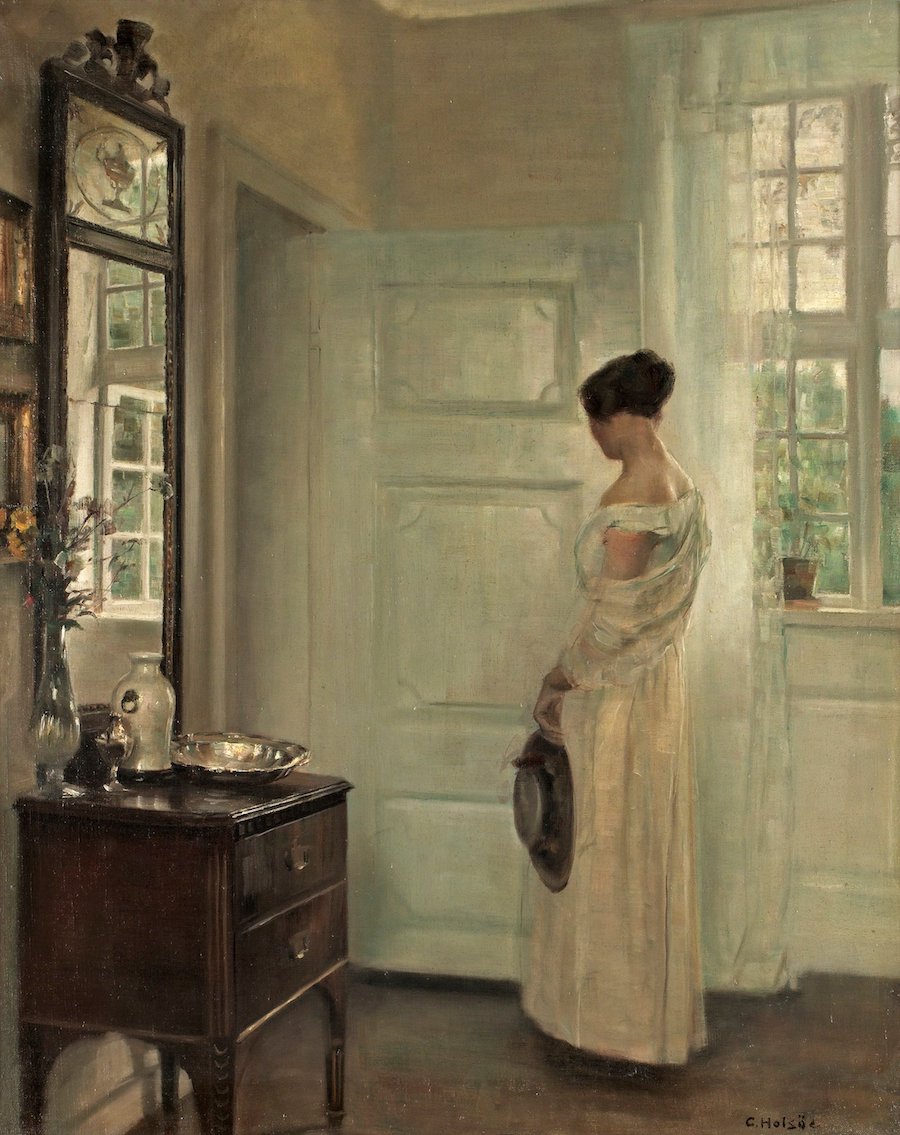
Carl Vilhelm Holsøe: Danish Vermeer?

Carl Vilhelm Holsøe (1863-1935) was a Danish artist (Wikipedia entry here) who painted a surprising number of similar scenes.

Those scenes were interiors with similar windows and furnishings populated by a young woman. Superficially, this is similar to a number of the known works by the famed Dutch artist Johannes (Jan) Vermeer where there was a window towards the left side of the painting, one or a few human subjects (usually female), and varying room décor.

Holsøe painted other subjects -- often different interiors -- but I thought it would be fun to present a set of his paintings that portray essentially the same sort of thing. Besides paned windows, some on French doors, nearly every painting contains a tall, narrow mirror. Titles are omitted in the Gallery below.

Gallery

The general setting without a young woman.


Finally, Holsøe provides The Old Switcheroo -- the woman is outside.

Monday, October 8, 2018

Kerry Ury's Nighttime Scenes

Let's call it a mini-genre. Maybe even a micro-genre. I'm thinking of urban nighttime scenes -- exteriors and interiors. Many artists depicted these sorts of things on occasion, but few devoted sizable amounts of their careers to it. Toulouse-Lautrec's cabaret work might qualify. Another artist, and one who is known for dealing with the night, is Leo Lesser Ury (1861-1931).

Ury's Wikipedia entry is here, and from there you can link to a slightly longer German version. The latter mentions that Ury feuded with Max Liebermann, and Liebermann's entry (which seems to be taken from an online translation, given its awkward phrasing) notes that Liebermann and Lovis Corinth also were feuding. Note to self: I need to learn more about Liebermann 'cause he sounds interesting.

As for Ury, his career received boosts from Adolph Menzel and Corinth. His personality seems to have been that of a loner, and I found no note of him ever marrying. But his art was well-regarded in his day, and I noticed that one of his pastels was auctioned for more than $200,000 a while ago.

Ury's style doesn't much appeal to me. That said, I find his oils and pastels interesting due to their subject-matter. That's probably because the period of European history that I study the most is from around 1860 to the end of World War 2. I'd love to hop into the nearest time machine and visit Berlin circa 1910.

Gallery

Unter den Linden - 1922
Unter den Linden is Berlin's main street. At one end is the Brandenburg Gate, the other is just short of the Museum Island, and between are such items as a university, some embassies, and the Adlon Hotel. The view above seems to be from on the north side near Pariser Platz, looking east.

Brandenburger Tor - Brandenburg Gate - mid-1920s
Looking west on Unter den Linden in Pariser Platz. I include these daytime scenes to show another side of Ury's work.  Now to the night stuff ....

Parisian Boulevard by Night - 1880s

Im Café Bauer, Berlin - 1888-89

Abend im Café Bauer - Evening in Café Bauer - 1898

Im Café Victoria, Berlin - 1904

Couple in a Café - pastel - 1910

Reading Newspapers in a Café - pastel - 1913
A café scene, but in daytime. I include it because of the depiction of reflected light on the tabletops.

Café de la Paix bei Nacht, Paris - 1920
Hard to tell the point of view, but the background is most likely Avenue de l'Opéra even though it seems too brightly lighted.

Vor dem Café (Berlin bei Nacht) - By the Café / Berlin at Night - 1920s

Rainy Night, Berlin - 1920s

Monday, February 5, 2018

N.C. Wyeth Does Modernism, Meets George Washington

It isn't unheard-of for a popular culture figure to disparage the works that brought fame and prosperity and to try doing something supposedly "higher." Examples include portrait artist John Singer Sargent and illustrator Dean Cornwell taking up mural painting. Or Arthur Conan Doyle trying to unharness himself from his famed creation Sherlock Holmes.

So it was with master illustrator N.C. (Newell Convers) Wyeth (1882-1945), Wikipedia entry here. As the link mentions, by the time he was well-established as an illustrator, he began to hate being a slave to that trade and began to create Fine Arts paintings. Prudently, he maintained his illustration career to preserve hearth, home, and lifestyle.

In September I re-visited the Brandywine River Museum of Art that features the works of the Wyeth family. On display were several of N.C.'s paintings done in the fashionable 1920s-1930s semi-Modernist vein. I also bought this catalog for a 1995 exhibit dealing with that subject.

According to it, Wyeth felt liberated and highly creative when doing such paintings, derivative though they actually were. And in my judgment, they were generally inferior to his illustration work. This post features a painting titled "In a Dream I Met General Washington" (1930). I might deal with other such works in future posts.

Gallery

The museum's image of the painting.

A detail photo that I took. This and the following images of mine can be greatly enlarged by clicking on them.
Here we see Wyeth, wearing his usual knee-britches, paintbrushes in one hand, palette in the other, facing the great man.

Landscape towards the upper-right corner. Thinly-painted for the most part. The stylized, rounded hills and tree forms were an emerging Regionalist cliché, as Grant Wood was doing the same sort of thing in 1930.

Here Wyeth tosses in a battle scene.

And includes his young son Andrew Wyeth sketching.

Monday, January 22, 2018

Analytical Cubism Portraits

Wikipedia has this extensive entry dealing with Cubism. Early on, it states:

"Historians have divided the history of Cubism into phases. In one scheme, the first phase of Cubism, known as Analytic Cubism, a phrase coined by Juan Gris a posteriori, was both radical and influential as a short but highly significant art movement between 1910 and 1912 in France. A second phase, Synthetic Cubism, remained vital until around 1919, when the Surrealist movement gained popularity. English art historian Douglas Cooper proposed another scheme, describing three phases of Cubism in his book, The Cubist Epoch." Those were "Early," "High" and "Late" Cubism, and the entry uses that concept to organize its discussion.

The peg I'm using for this post is the Analytical Cubism concept, whereby artists were supposedly presenting a subject by simultaneously using several different points of view in order to show it more completely than traditional art's single viewpoint.

I find it hard to believe the early cubists were serious in this regard. After all, Pablo Picasso (1881-1973), an inventor of Cubism, was something of a prankster.

Consider the hypothetical case of an artist seriously making a Cubist portrait using perhaps half a dozen different perspectives. The result will probably be an image that is so fragmented that only the artist himself would know what segments of his painting or drawing came from which viewpoint. A viewer of the work might be able to identify how a few fragments originated, but would be at a loss to comprehend how the entire work was assembled.

In other words, instead of showing a more complete view of the subject, the result is that even less of the subject is understandable to a viewer than would have been the case for a traditional portrait.

Some examples of early cubist portraits are shown below.

Gallery

Pablo Picasso: Portrait de Daniel-Henry Kahnweiller - 1910
If you didn't already know what art dealer Kahnweiler looked like, could you form an accurate image of him using only the material presented in this "portrait?"

Pablo Picasso: Portrait de Ambroise Vollard - 1910
Here Picasso comes closer to depicting Vollard as others actually would see him.

Pablo Picasso: Girl With a Mandolin - 1910
Not strictly a portrait, as he made no attempt to break the subject's face into many fragments -- he just simplified/abstracted.

Albert Gleizes: Portrait de Jacques Nayral - 1911
Albert Gleizes (1881-1953), background here, besides being a painter, was a cubist theoretician who co-authored the 1912 book "Du Cubisme." He remained a cubist of sorts for much of his career, so unlike Picasso he should have been serious. But the example shown here simply has the subject's face and hands reduced slightly in the direction of faceting. Only other parts of the figure plus the rest of the setting are what most would consider cubist.

Albert Gleizes: Portrait de Mme H. M. Barzun - 1911
The same can be said regarding this portrait.

"Du Cubisme" was co-authored by Jean Metzinger (1883-1956), who I wrote about here. Metzinger was a cubist for a while but later works were far more representational. This painting is largely a matter of using simplified shapes and faceting, though a slight amount of perspective-twisting can be seen.

Jean Metzinger: Portrait de Mme Metzinger - 1911
When it came to portraying his wife, Metzinger fell back to the practice of faceting features and putting cubist decoration in the background as Gleizes did.

What the above gallery suggests is that even committed cubists often had to hold back from a hardline "analytical" approach when making portraits. Perhaps this compromise with purity had to do with the practical matter of portrait subjects wanting to be shown in a largely recognizable manner.