Monday, April 20, 2020

John Bulloch Souter, Scottish Painter

I find John Bulloch Souter (1890-1972) hard to pin down artistically, though it can be fairly said that his style was representational and that he was good at likenesses. Some biographical information is here.

Below are examples of his work.

Gallery

Mrs Ogilvie - 1914
I like this portrait very much: a striking image.

The Birth of Venus
This seems out-of-character. Perhaps it was made early in his career, though one Internet source speculates it might have been painted in 1923. Regardless, it was auctioned by Christie's as one of his works.

Portrait of an Unknown Officer - c.1925

The Yellow Dress
Various titles are assigned to this painting.

Fay Compton (1894–1978) (possibly as Crawford in 'This Woman Business' by Benn W. Levy) - 1927
To me, this is not up to Souter's likeness standards.
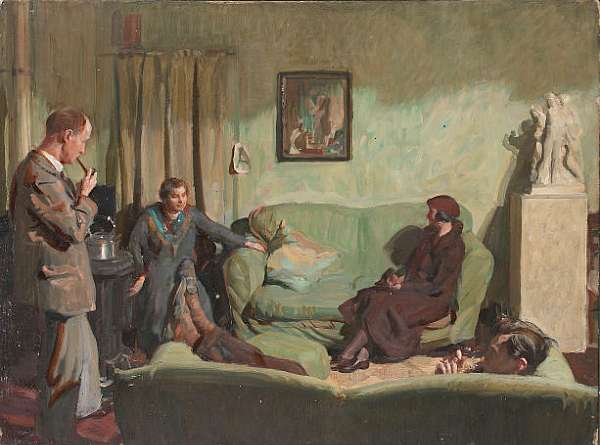
A Chelsea Conversation
Different, casually done.

Mrs C. H. Souter (the artist's sister-in-law)
Fashionably Japanese.

Portrait of the Countess of Cranbrook
Again no date, so I'll guess it's from the mid-1930s or the 1950s to judge by her hairdo.

Admiral of the Fleet Sir John H. D. Cunningham (1885–1962), GCB, MVO, First Sea Lord and Chief of Naval Staff (1946–1948) - c.1947
Interesting that this personage is shown holding a cigarette.

Artist's Wife with Lace Collar
I really like this sketch because the facial expression is so life-like. Reminds me of a lady friend of days gone by.

Thursday, April 16, 2020

Stanley Cursiter, Painter, Keeper of the National Galleries of Scotland

Stanley Cursiter (1887-1976) was at his best when depicting people, though he dabbled in Modernism early in his career and abstraction towards the end. As this Wikipedia entry mentions, he was born in the Orkney Isles to a well-off family, was an officer during the Great War, and served as Keeper of the National Galleries of Scotland.

I plan to write in more detail about his paintings of women. For now, I offer a sketch of the styles he used. Many of the images are copyrighted by the artist's estate and are shown here to acquaint readers with his work so that they might appreciate his skill.

Gallery

Tea Room - 1913
We begin with several paintings made in 1913.  This was a time when he did a good deal of stylistic experimentation.  Here he simplifies his subjects while painting with heavy brush strokes.

Rain on Princes Street - 1913
Princes Street is Edinburgh's main shopping street.  This somewhat Cubist work shows umbrellas, faces, the facades of stores on the right and stylized versions of monuments that can be seen nearby.

Regatta - 1913
Not Cubist here, but an exercise in patterns with recognizable people and flag of England.

The Sensation of Crossing the Street – West End, Edinburgh - 1913
Finally, fragmented patterns with an image of a woman's face with stylized coloring.

Twilight - 1914
Yet a year later Cursiter painted this representational scene.

Girl with a Jug - 1921
Representational works continued following the Great War.  Here is a combination of portraiture and still lifes.  This is the style that he did best, in my opinion.

Musicians - 1923
I'm not sure about the date because other paintings from that time resemble the previously shown style.

Margaret Baikie of Tankerness - 1946
A later portrait.

Abstract - c. 1962
Finally, one of the abstractions he painted in the early 1960s.  This sort of image might easily have been made 50 years earlier.

Monday, April 13, 2020

Anatol Kovarsky's Cartoons About Art

Anatol Kovarsky (1919-2016) was born in post-revolutionary Russia, lived in Poland and France until 1941, then was able to escape to the USA. He became a cartoonist for The New Yorker magazine, later concentrating on painting. Some biographical information can be found here, though you will have to scroll down to find it.

Given The New Yorker's method of supplying cartoon ideas to its cartoonists, it can be difficult to be sure which ideas came from the artist and which from others. That said, Kovarsky cartoons had a unique "feel" to them, so I suspect many or even most ideas were his own.

Art was a major subject for him. Below are examples.

Gallery


Now for two cartoons that might be considered politically questionable nowadays ... enjoy!


Thursday, April 9, 2020

John Melhuish Strudwick, Disciple of Burne-Jones

John Melhuish Strudwick (1849-1937) seems to be classified as a Pre-Raphaelite, though that's not strictly so. He was born about the time the Brotherhood was formed, and therefore was never a member and was of the following generation. I think a fair label would be "Victorian."

Strudwick was greatly influenced by Edward Burne-Jones (1833-1898), for whom he was an assistant for a while. It seems that he painted slowly, so his production was not large. Contributing to this was that his sponsors dropped him in the early 1900s and he essentially gave up painting for the next 30 years of his life. This is noted here and here.

Apparently he had salted enough money aside so as to exist without sales of paintings. I wish I knew more about his curious circumstances.

As for his art, it is well-crafted in the Burne-Jones manner.

Gallery

A Golden Thread - c.1885

Circe and Scylla - c.1886

Acrasia

'Oh, swallow, swallow' - 1894

Saint Cecilia - c.1896

Virgin and Child - 1901

When Apples Were Golden and Songs Were Sweet but Summer Had Passed Away - c.1906

In the Golden Days - 1907

Monday, April 6, 2020

Robert Weber, New Yorker Cartoonist

Robert Maxwell Weber (1924-2016) was a New Yorker magazine cartoonist for many years, though his professional career began as a fashion illustrator -- unusual for a cartoonist. He probably didn't realize at the time what a wise career move that was, because fashion illustration began to give way to photography in the 1960s whereas the New Yorker continues to feature cartoons.

For more information on Weber you might link here and here.

Weber's style was sketchy, and done often using charcoal sometimes supported by wash. I suppose he might be rated as an above-average New Yorker cartoonist (its cartoons were well above the general average). But he did not achieve the fame of members of the previous New Yorker generation such as Charles Addams and Peter Arno.

Gallery

"In a way I am kind of famous.  But you've probably never heard of me unless you happen to travel in actuarial circles."
I happen to be a demographer, a distant cousin of actuarial work. Makes me wonder how famous I am.

"These projected figures are a figment of our imagination.  We hope you like them."
As the author of a book on population forecasting, this cartoon also hits home.

"You've been very bad, so we're sending you back to New York."
Oh so true.

"Billy is turning out to be quite the little artist."

"Do you mind if I say something helpful about your personality?"

"I'm back.  The Brie's not ripe."

Thursday, April 2, 2020

John Hubbard Rich, Not Quite a California Impressionist


The image above is "The Idle Hour" (1917) by John Hubbard Rich (1876-1954), painted about three years after he moved from the Northeast to Los Angeles. I like it very much.

Rich's tiny Wikipedia entry is here. Although his work was done in a painterly style in the spirit of the contemporary California Impressionists, I didn't notice any of his works on the Internet that were the kind of landscapes that group painted. Indeed, Rich's visible works are almost entirely portraits and indoor scenes.

Gallery

Lady with Teacup
I don't have a date for this, but from the style and subject matter, it looks like it was painted in Boston before Rich moved to California.

Woman in Blue Gown
The same might be said for this painting.

Carmen
Now for for some California paintings.

Elizabeth Josephine Harris - 1918
In the same spirit (and apparently the same clothes and fan) as the painting atop this post.

The Japanese Lantern - 1916
Another Oriental sort of theme.

Portrait of a woman
I don't have a date for this.

Yellow Teapot, or Daydreams - c.1929
Domestic scene with a touch of landscape outside the window.