Monday, March 29, 2021

Philip de László: Pre- Age 40 Portraits

Philip de László (1869-1937) was one of England's most prominent portrait painters during the first third of the 20th century.  Some considered him the successor to John Singer Sargent, and I used that thought as the "hook" for this post about him.  László's Wikipedia entry is here.

Today's post presents some of the portraits he made before he was 40 years old, so his skills were fairly mature but perhaps not fully formed.  Pre-1899 works were not evident in a Google search, though I surely must have missed some.  Those paintings were made when he lived in Budapest.

The portraits below are arranged in approximately chronological order.

Gallery

Empress Elisabeth of Austria-Hungary - 1898
She was killed in September of that year, so it is possible that this portrait is posthumous.  That said, its sketchy quality suggests that she might have sat for him.

Kaiser Franz-Joseph of Austria-Hungary - 1899

Adele van Loon - 1901

Pope Leo XIII - 1900
This might have been a study for a larger, more formal painting.

Jan Kubelik - 1903

Princess Max Egon von Hohenlohe-Langenburg, née María de la Piedad de Yturbe - 1906
But this time, László's style is beginning to approach maturity.

Princess Victoria Alexandra Olga Mary of Wales - 1907
Signed, but not "finished."

Princess Andrew of Greece and Denmark, née Princess Alice of Battenberg - 1907

Condesa Meyendorff - 1908

Kaiser Wilhelm II - c. 1908
Again, more a study than a completed work.  I'm assuming the Kaiser sat for this.

Monday, March 22, 2021

Eugene Savage, Moderne Muralist

Eugene Francis Savage (1883-1978) was a muralist and academic whose major works were made in the late 1930s.   His Wikipedia entry is here.

Nowadays he is best known for a set of murals featuring scenes from Hawaii and its history.  But he painted other murals and paintings, some of which are shown below.

His style was clearly in the 1930s Moderne vein, where a touch of subject simplification was expected.

Gallery

Aloha ... The Universal Word - c.1940
This is one of Savage's well-known murals painted for the Maison Navigation Company that had ocean liners such as the Lurline that plied between Honolulu and California.  On ship, the murals served as the basis for menu covers.  Standard Savage visual fare included bold, slightly simplified shaping of human bodies and stacked groups of similar people such as the group of women seen at the far left.


Competition painting, American Academy in Rome - 1912
Painted when in his late twenties, this is fairly traditional.  Very striking female nude, indicating that he might have taken a different artistic path than the one he chose.

Armistice - 1926
An early mural featuring stacked figures having odd expressions on their faces.  Murals seem to work best when visually "busy," and Savage painted many busy murals.

Biscayne Holiday - 1936
Again, stacked figures and strong body shaping.

Carrier of News and Knowledge - post office mural - 1937
Even though Savage was on the Yale University faculty, he seems to have been involved with Depression-era Federal art projects.

Spirit of Oshkosh - mural study - 1937
Oshkosh is a city in Wisconsin, and this might be a study for a post office mural intended for that place.

Seaside Market - 1942
Not a mural, I suppose.  But a genre painting in the spirit of 1930s artists such as Reginald Marsh and Paul Cadmus.  Perhaps a view down Savage's nose from the heights of Yale University.

Spirit of the Land Grant College - 1961
A comparatively late work.  It retains much of his late-1930s feeling -- though a bit simplified and lacking the stacked groups of people.

Monday, March 15, 2021

John W. Waterhouse Studies and Sketches

John William Waterhouse (1849-1917) was an important British painter, especially during the period 1890-1910.  He mostly dealt with classical, mythological and literary subjects featuring attractive woman.  His Wikipedia entry is here.

I am interested in how painters work, so from time to time present example of sketches, studies, and uncompleted paintings that offer insights.

Below is a set of such images by Waterhouse.

Gallery

An Eastern Interior with Seated Girl - 1886
I rate this as an oil sketch rather than a study for a more finished painting, but I might be wrong.

Head of a girl - sketch
Focus is on her face, the rest is roughly indicated.

Jason and Medea? - 1907? - study
Her face is largely finished, so I wonder if Waterhouse was thinking of making a painting of Medea only.  Given the roughed in background, it's possible that this was an unfinished work.

"Nymphs Finding the Head of Orpheus" -- a study of the nymph at the left - c.1910

Study for "The Head of Venus in the Awakening of Adonis" - c.1899

"Maidens Picking Flowers by a Stream" - 1911
This has the look of an unfinished painting rather than a study.  An Internet search turned up no other Waterhouse image of that title.

Monday, March 8, 2021

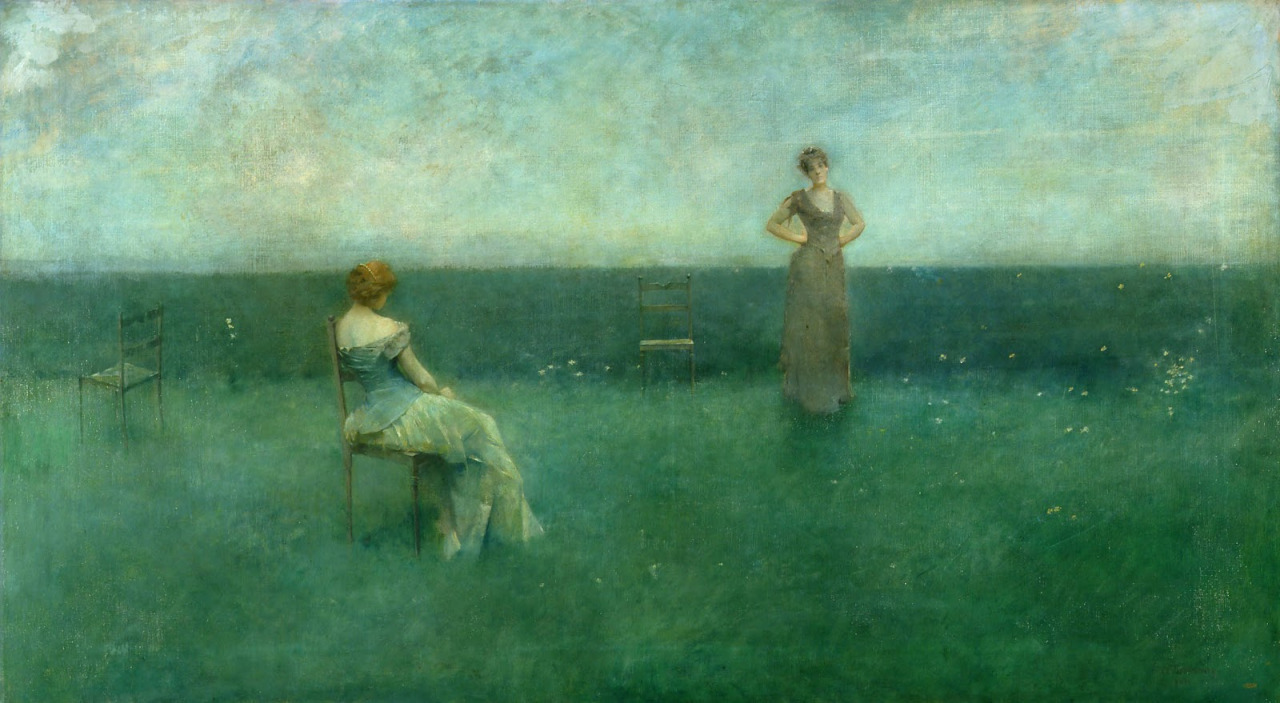
Thomas Wilmer Dewing's Outdoors Scenes

Thomas Wilmer Dewing (1851-1938) was a prominent American painter during the late 1800s and early 1900s.  Trained in Paris at the Académie Julian in the late 1870s, his style was originally academic but soon became became something that might be described as "tonalist-representational" where his depictions ranged from fuzzy to fairly sharply done.  He did not disguise his brushwork.

Some background on Dewing is here, and I wrote about his scenes of women with musical instruments here.

His subject matter was almost exclusively women, so far as I can tell.  If he depicted men, that would have been while a student or if he ever painted portraits early in his career to earn some money.  A chalk drawing of the poet Walt Whitman is in the Smithsonian collection.

Today's post presents some of Dewing's outdoor scenes populated, as usual, by attractive, aristocratic-looking women.

Images are in approximate chronological order.  Seen on the Internet, at times there are color and sharpness variations of the same painting, so view my selection with the proverbial grain of salt.

Gallery

Summer - 1890

Summer - 1890

The Hermit Thrush - 1890

The Recitation - 1891

In the Garden - c.1893

The Garland - 1899

The Lute - 1904

Monday, March 1, 2021

Frank Schoonover Illustrates Mars

Frank Schoonover (1877-1972) was a member of the Brandywine School of illustrators, having been trained by Howard Pyle.  His Wikipedia entry is here.

Schoonover is best known for his outdoors North American scenes.  I wrote about one of them here.

He painted more subjects than that -- even illustrators as well known as Schoonover need income.  One such project was creating illustrations for Edgar Rice Burroughs' "A Princess of Mars," the first in his John Carter of Mars series.

Burroughs is best known for his Tarzan books, and Schoonover's John Carter seems to resemble J. Allen St. John's depictions of Tarzan. I wrote about St. John here and here.

Gallery

Here is the book's cover.

And this is Schoonover's cover illustration.  Carter's long hair strikes me as being Tarzan-like.  But his legs seem rather spindly for an athletic hero.  Dejah Thoris, the princess, has an Egyptian look.

Presumably Carter on this arrival on Mars from a southwestern USA cave with strange fumes.

Some Martians such as Dejah Thoris were human, but others had four arms, as can be seen in the background.

Dejah draws a map for Carter.  I find her arms unconvincing, but perhaps Schoonover needed to make adjustments in order to present the action.

Monday, February 22, 2021

Hans Makart, Who Influenced Klimt

Hans Makart (1840-1884) influenced Gustav Klimt and others, according to his Wikipedia entry.  I am not sure just what that influence might have been, because Klimt's trademark style did not emerge until nearly 15 years after Makart's death.

That said, Makart had a highly successful, prolific career despite his early death at age 44.

Having mentioned Klimt, I thought I might as well feature some Makart depictions of women because women were Klimt's favorite subjects.

The images below are in reverse alphabetical order just for the fun of it.  Given his comparatively brief career, I made no effort to track stylistic evolution.

Gallery

Zerline Gabillon - 1873

Sarah Bernhardt - 1881
Almost more of a sketch than a formal portrait.

Portrait of a Young Woman - c.1883
A fairly late work -- and she doesn't seem all that young.

Karoline Gomperz - c.1870
And this is comparatively early.

Gräfin Palffy
"Gräfin" is a reference for "Countess."

Dora Fournier-Gabillon - c.1879

Charlotte Wolter as Messalina - 1875

Anna von Waldberg - 1883-84.
Another late work.

Amalie Makart am Klavier

Adele Gräfin Waldstein-Wartenberg - 1874

Monday, February 15, 2021

Color Photographs ... Enhanced!!

From time to time I come across shops that feature large-format color photographic prints having dramatic views and striking colors.  Apparently there is a fairly strong market for such images.

In some cases those color schemes are not what I've ever seen in nature.  Are my eyes failing me?  Or were the original photos digitally enhanced?

Offhand, I don't know for certain, but I'm pretty sure there was some enhancing going on.  Check out my experiment below.

Gallery

The first two examples are by Peter Lik.  I've seen this one in his stores.  The subject is Manarola in Cinque Terre, Italy.  The buildings seem brighter than I think they should be, and the foliage more green. The sea seems more placid and blue than I would expect.

Here again the foliage green in the foreground strikes me as being a bit false.  The lighting on the clouds seems on the strong side, though I have seen such colors for Hawaiian sunsets.


Photo from an unknown source via lebisca.com.  Colors look exaggerated.

Now for my experiment.  This is an iPhone photo I took recently on the grounds of the Waikoloa Beach Marriott on Hawaii's Big Island.

I moved it to my iMac, selected it for Preview, and went to Adjust Color in the Tools menu.  Then I moved the Saturation bar to the extreme and made a few small adjustments to some other controls to achieve the result in the above image.  It seems similar to the kind of likely enhancements shown in the first three images.